Revision History
Rev. |
Description of Modification |
Date |
1. |
1st Issue |
14/12/2025 |
CONTENTS
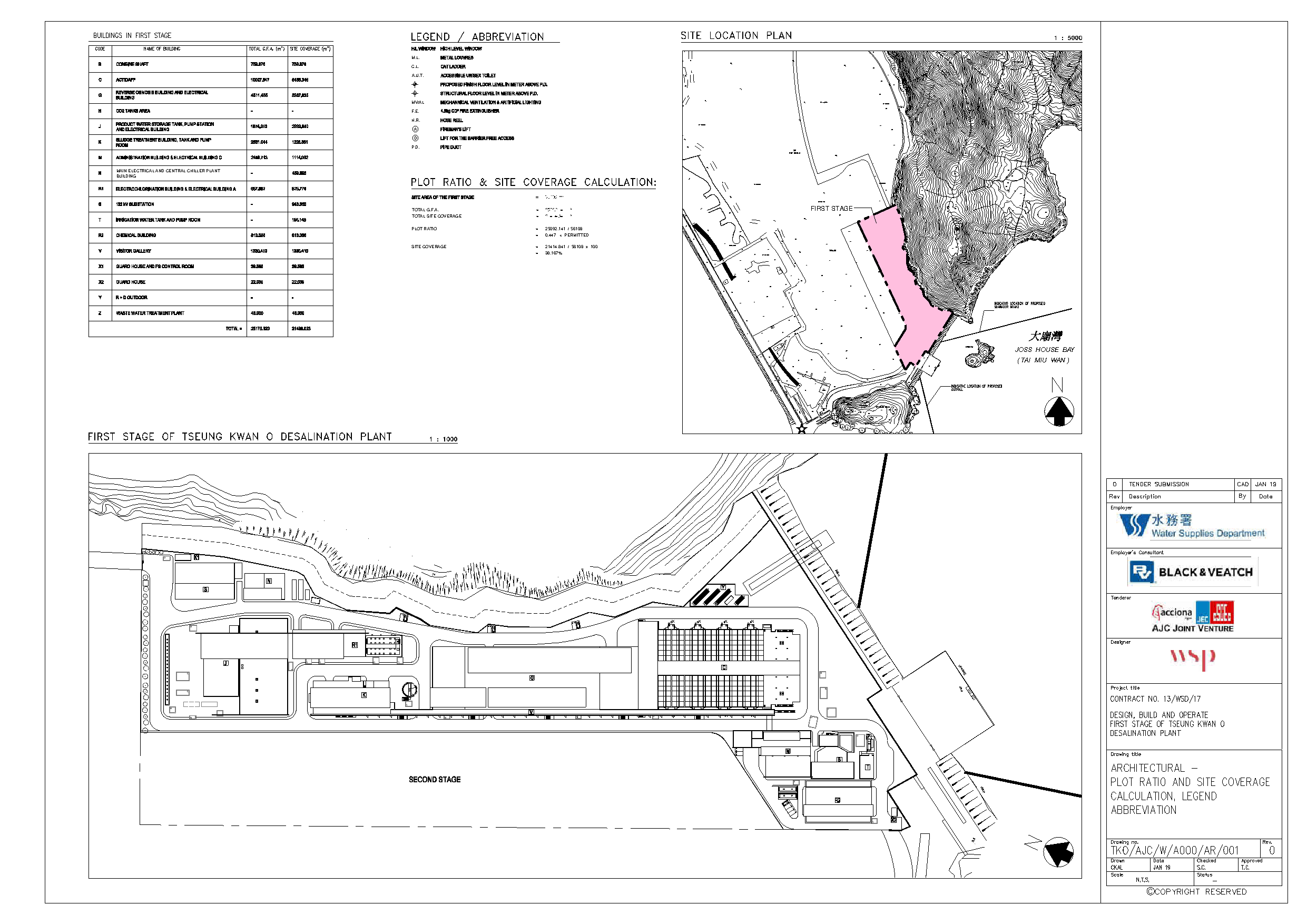
Appendix A Overview of Desalination Plant in Tseung Kwan O
Appendix B Summary of Implementation Status of Environmental Mitigation
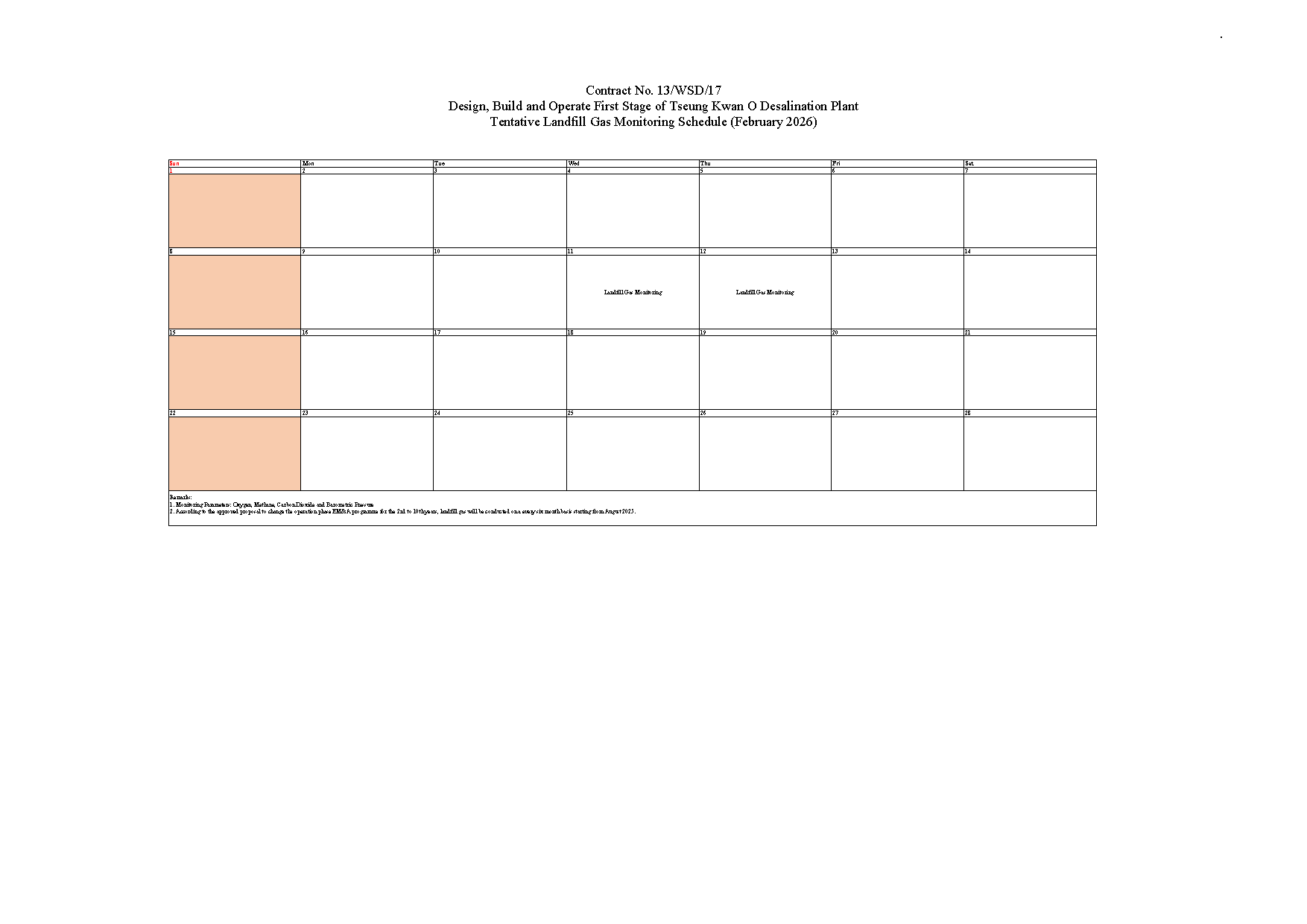
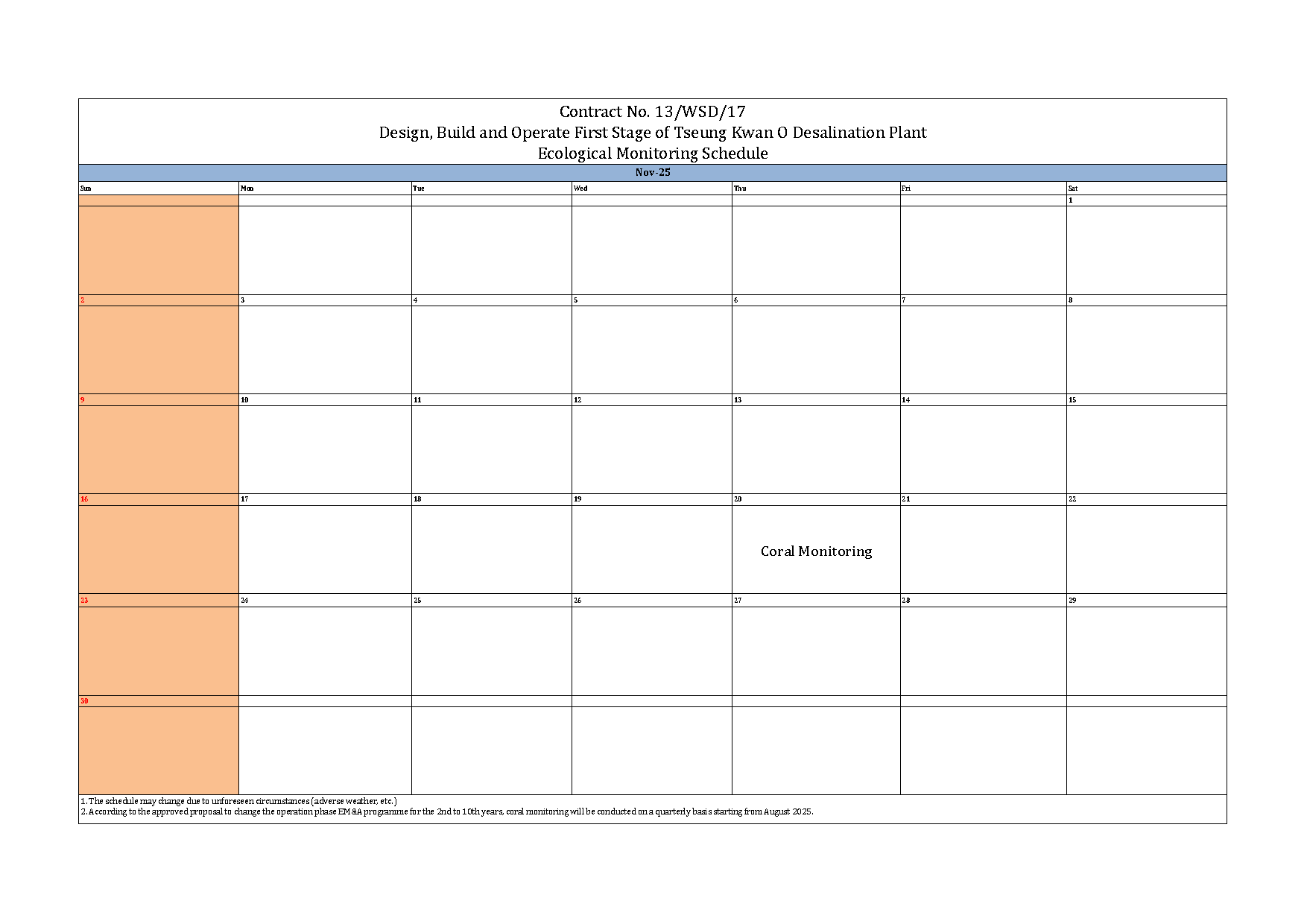
Appendix C Impact Monitoring Schedule
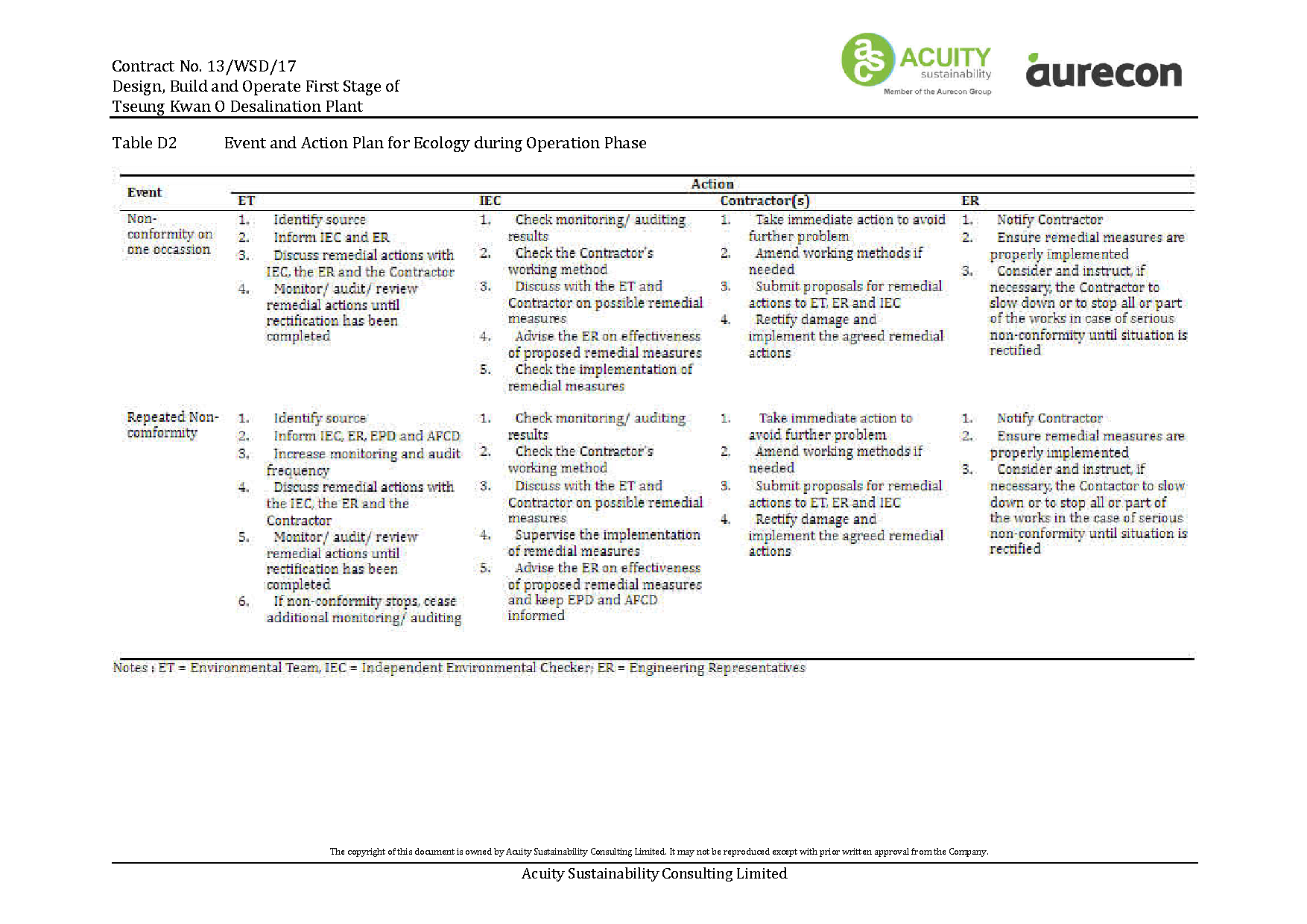
Appendix D Event/Action Plan
Appendix E Landfill Gas Equipment Calibration Certificate (Not Used)
Appendix F Landfill Gas Monitoring Data (Not Used)
Appendix G Waste Flow Table
Appendix H Ecology Survey Report
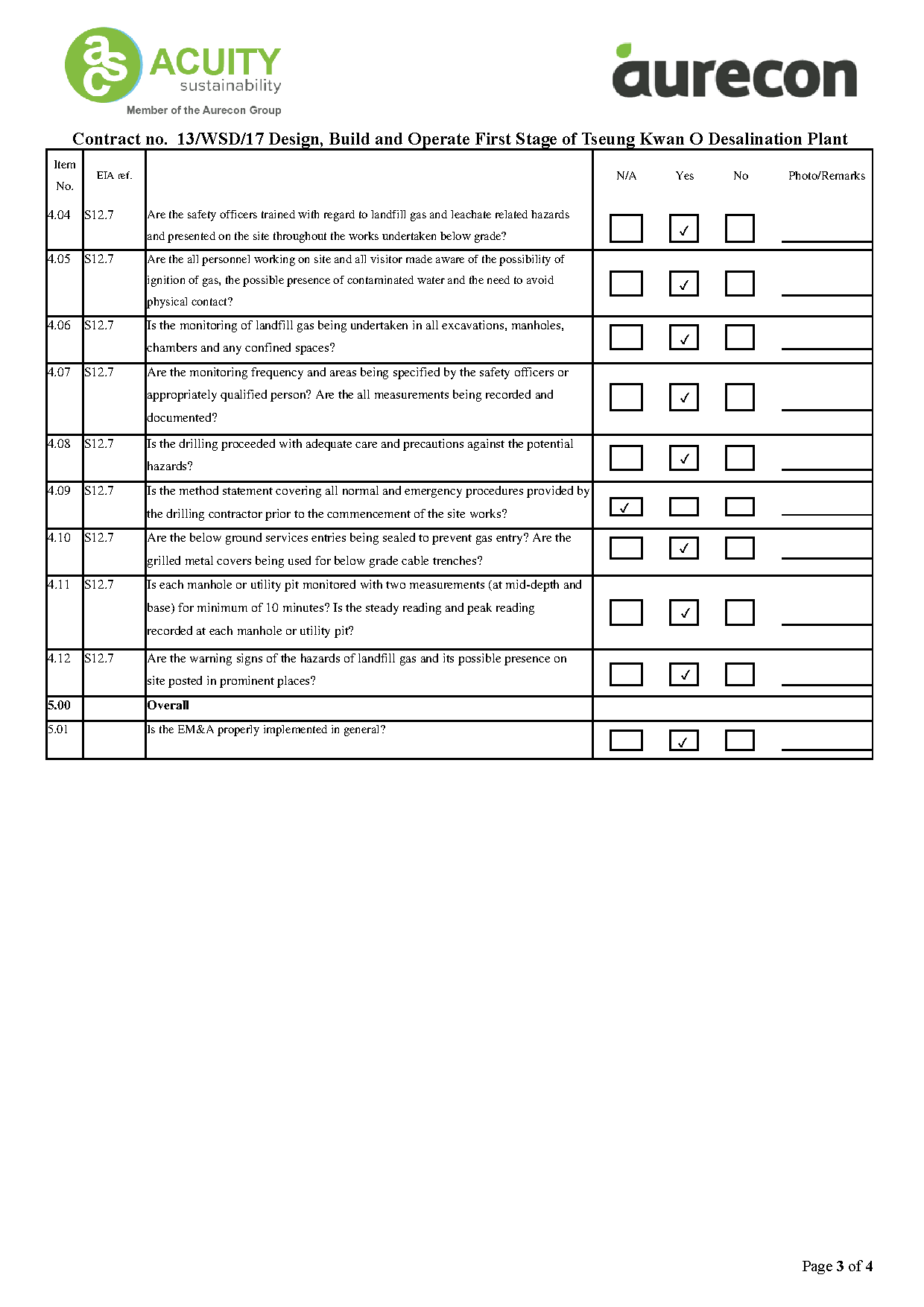
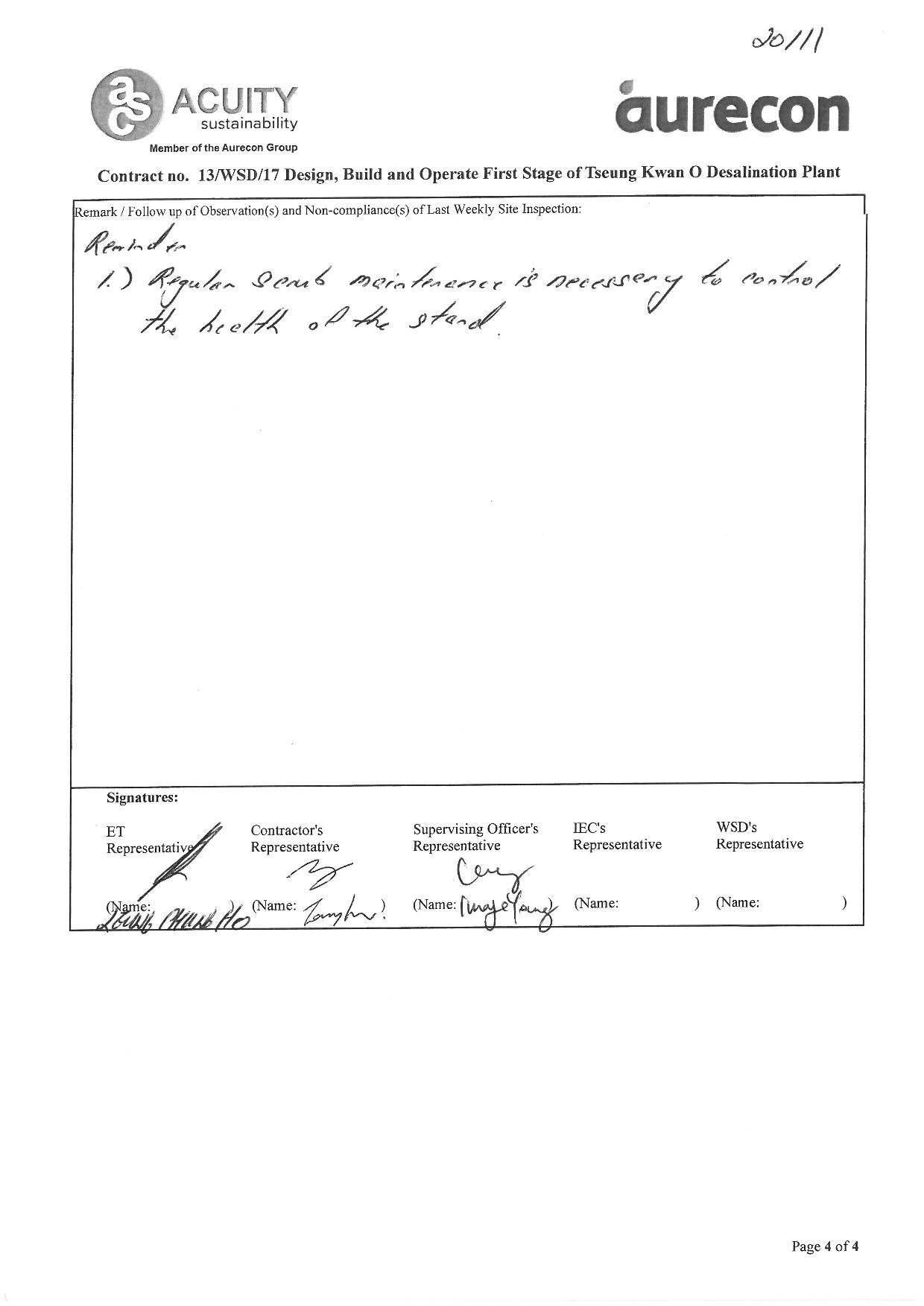
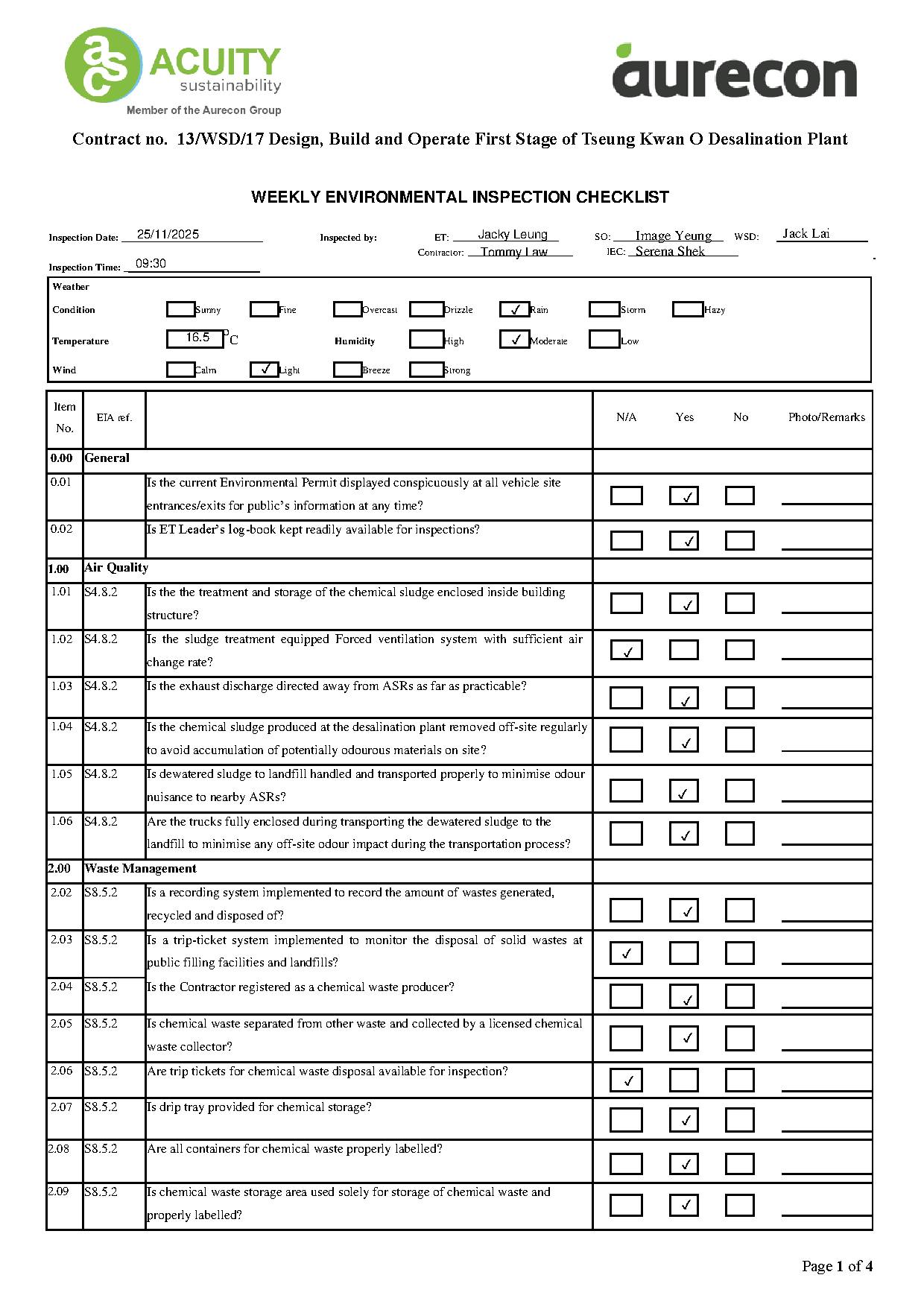
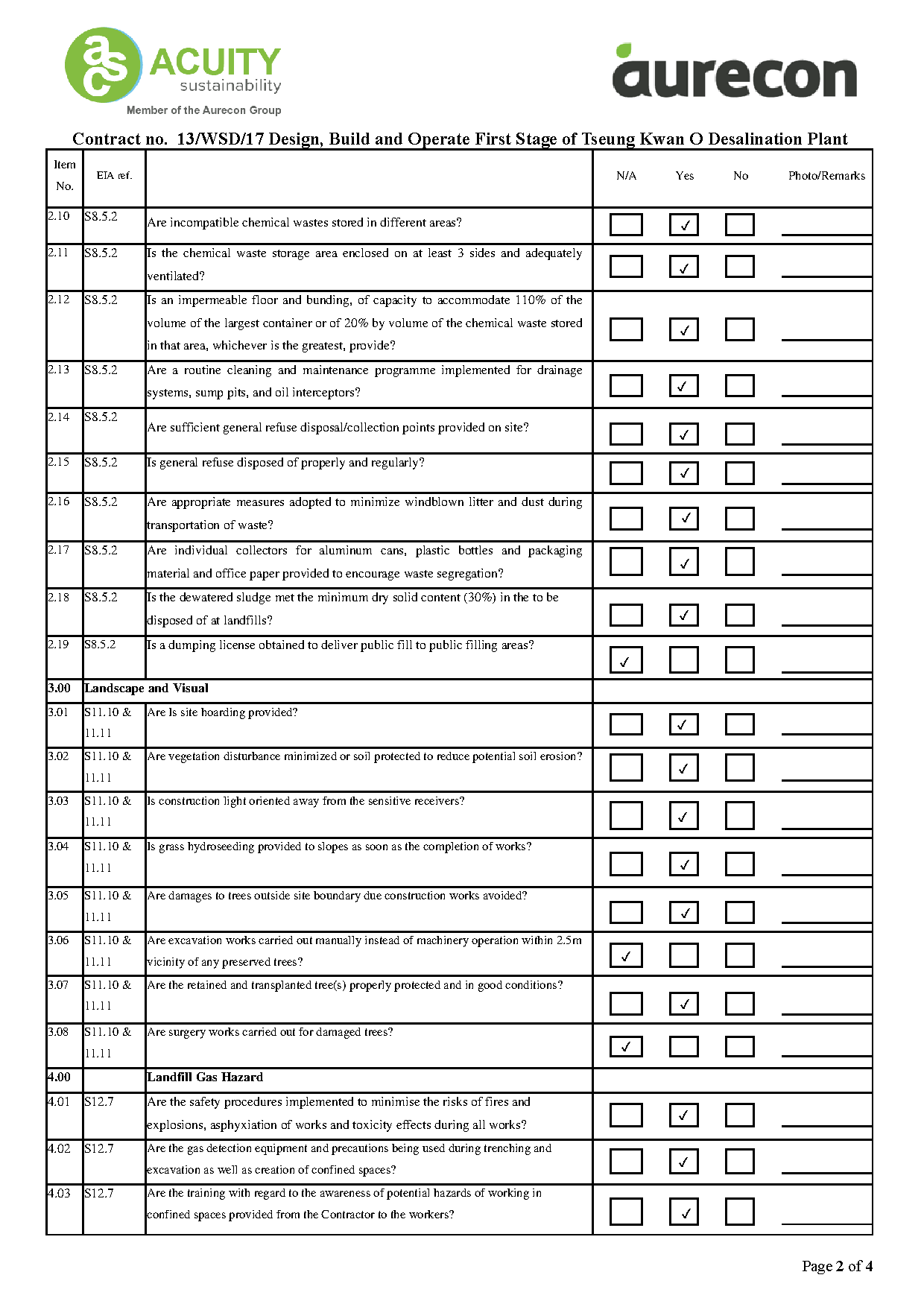
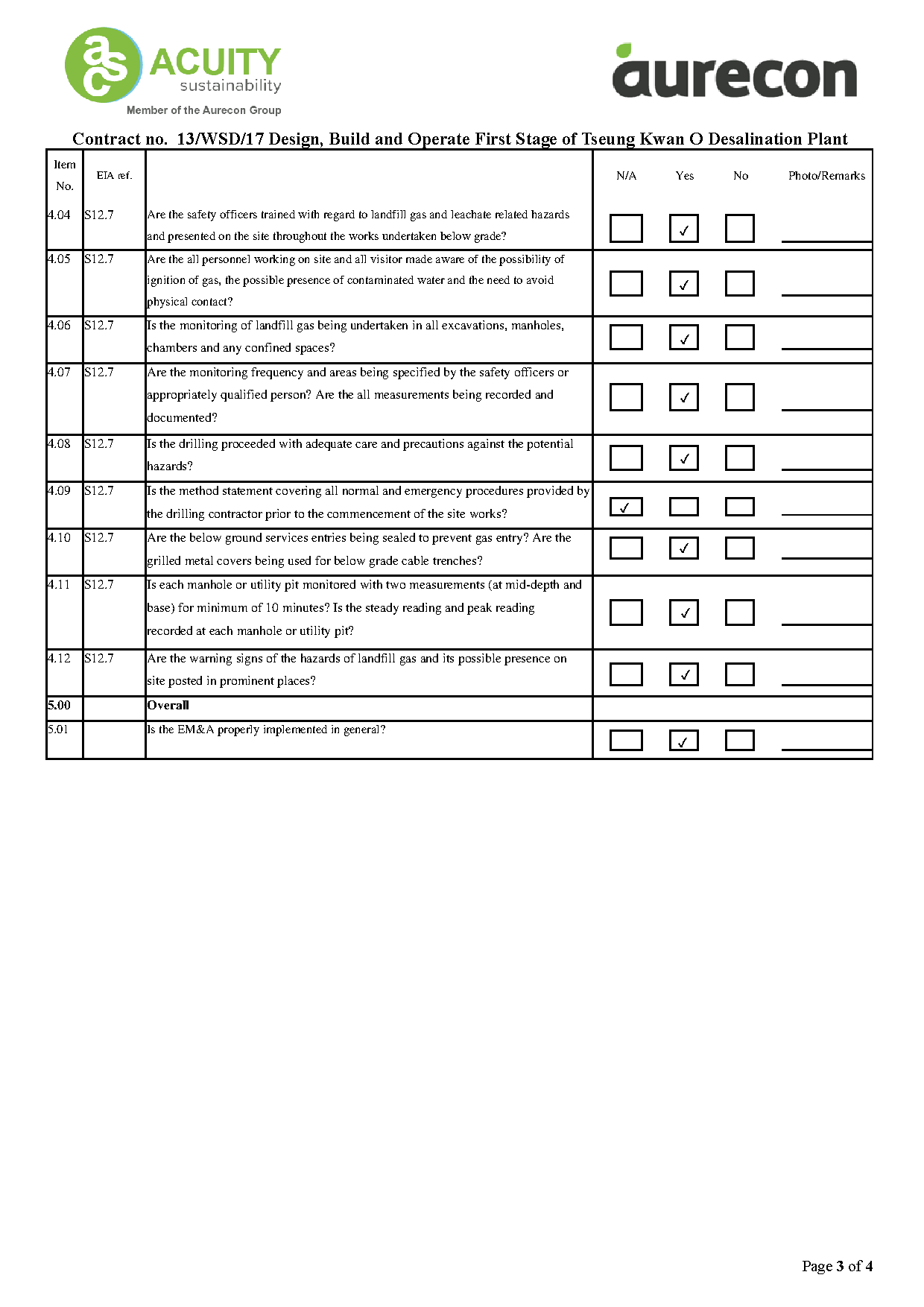
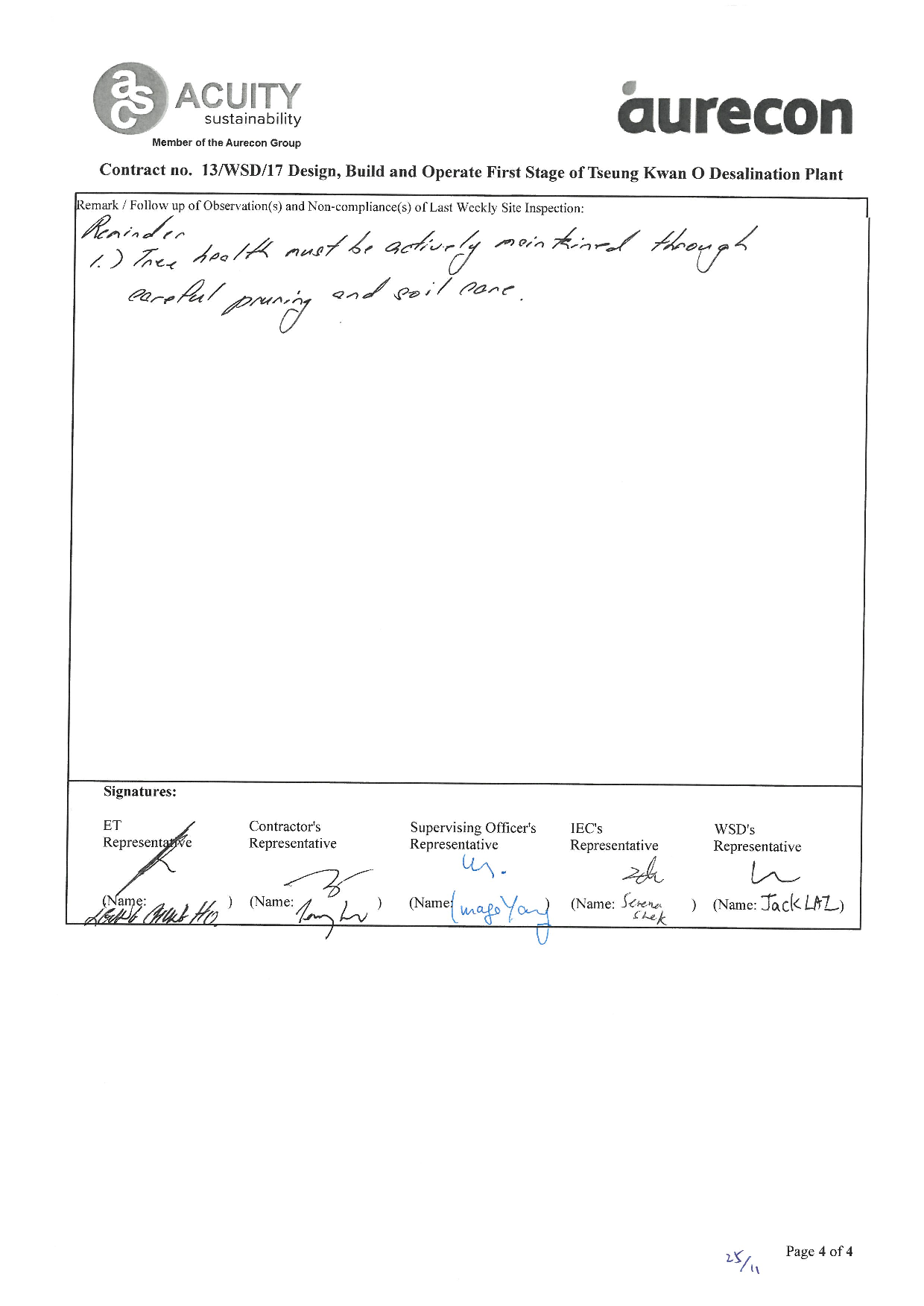
Appendix I Site Inspection Proforma
Appendix J Complaint Log
Introduction
A1. The Project, Design, Build and Operate First Stage of Tseung Kwan O Desalination Plant (TKODP), is a Designated Project under the Environmental Impact Assessment Ordinance (Cap. 499) (EIAO) and is currently governed by a Further Environmental Permit (EP No. FEP – 01/503/2015/B) for the operation phase of the Contract.
A2. In accordance with the Environmental Monitoring and Audit (EM&A) Manual for the Contract, EM&A works for marine water quality, waste management and ecology should be carried out by Environmental Team (ET), Aurecon Hong Kong Limited (Aurecon), during the Tseung Kwan O Desalination Plant.
A3. The TKODP commenced the operation stage on 1 July 2024. This is the 17th Operation Phase Monthly EM&A Report, prepared by Aurecon, for the Contract summarizing the monitoring results and audit findings of the EM&A programme at and around Tseung Kwan O Area 137 (TKO 137) during operation of Tseung Kwan O Desalination Plant in November 2025.
A4. The EM&A programme for this contract has covered environmental monitoring on water quality and Contractor's environmental performance auditing in the aspects of dust, landfill gas, water quality, waste management, Landscape and Visual and Ecology.
Summary of exceedance & investigation & follow-up
WATER QUALITY MONITORING
A5. The first-year operation phase marine water quality monitoring was completed on 30 June 2025. No marine water quality monitoring was conducted during the reporting period.
A6. According to the approved proposal to change the operation phase EM&A programme for the 2nd to 10th year, continuous monitoring of effluent quality was discontinued and replaced with effluent water monitoring in compliance with discharge license requirements starting from 15 August 2025.
Ecology Impact Monitoring
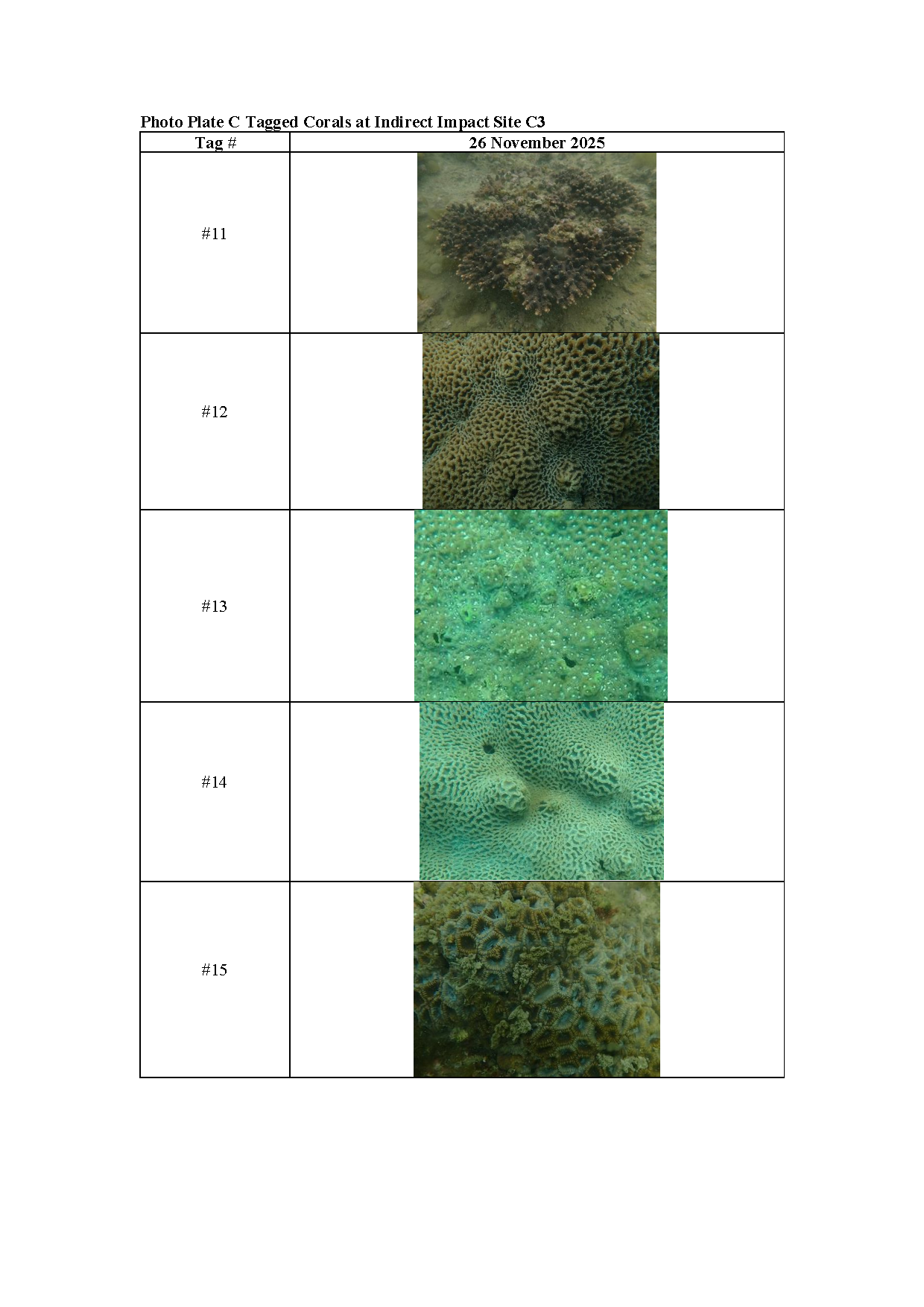
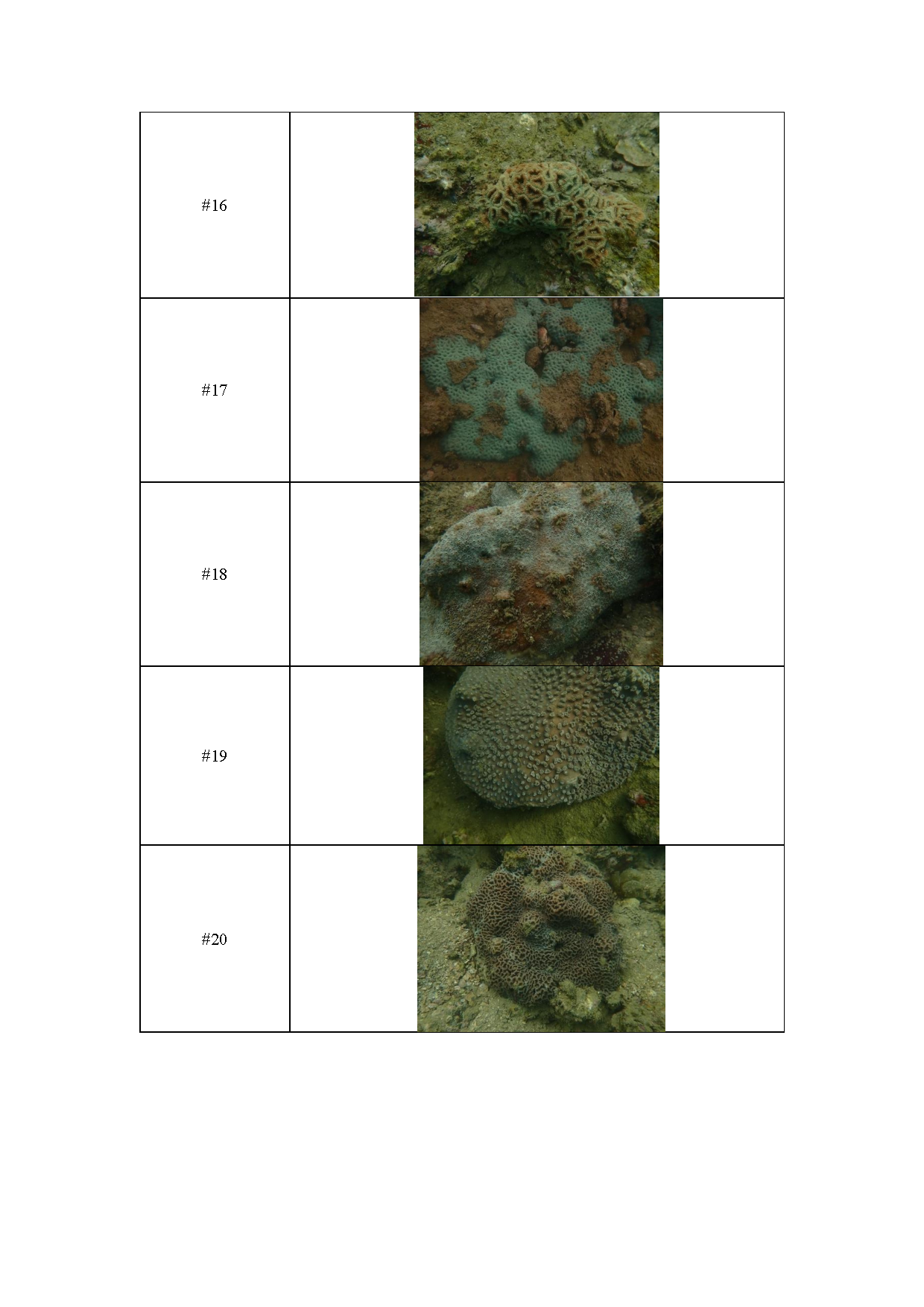
A7. Coral monitoring was conducted on 26 November 2025. A total of 30 tagged coral colonies (10 at control site and 20 and two indirect impact sites) were monitored. 3 coral colonies with mortality in Site C3 were recorded, all other coral colonies were good in general.
A8. According to the approved proposal to change the operation phase EM&A programme for the 2nd to 10th year, coral monitoring will be conducted on a quarterly basis starting from August 2025.
A9. Operation phase fishery monitoring for wet season 2025 was carried out on 16 and 23 August 2025. Details of the survey report were included in the October Monthly Report.
Landfill Gas Monitoring
A10. In this reporting period, no landfill gas monitoring was conducted.
A11. According to the approved proposal to change the operation phase EM&A programme for the 2nd to 10th year, landfill gas monitoring will be conducted on a six-month basis starting from August 2025.
Weekly Site Inspections
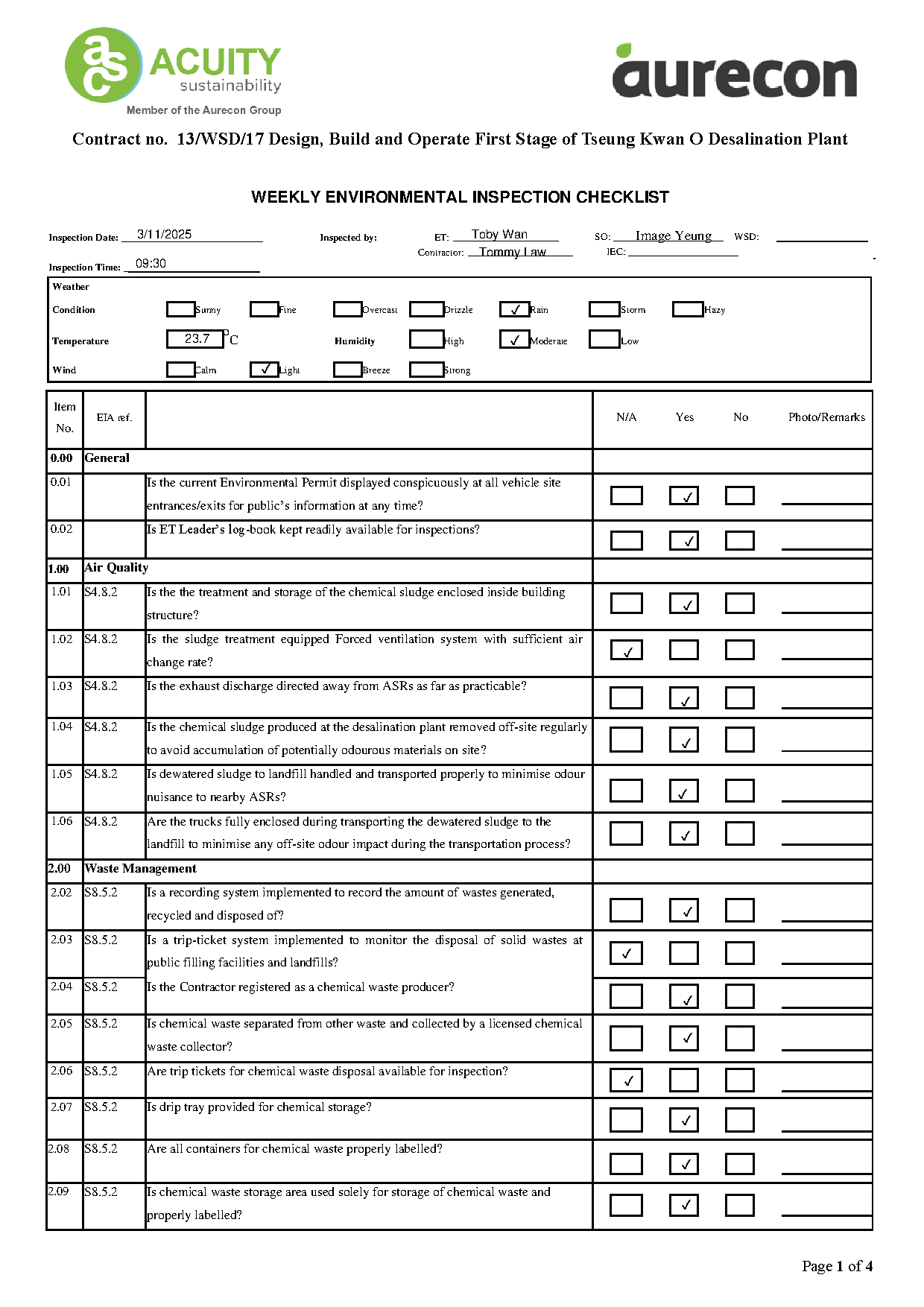
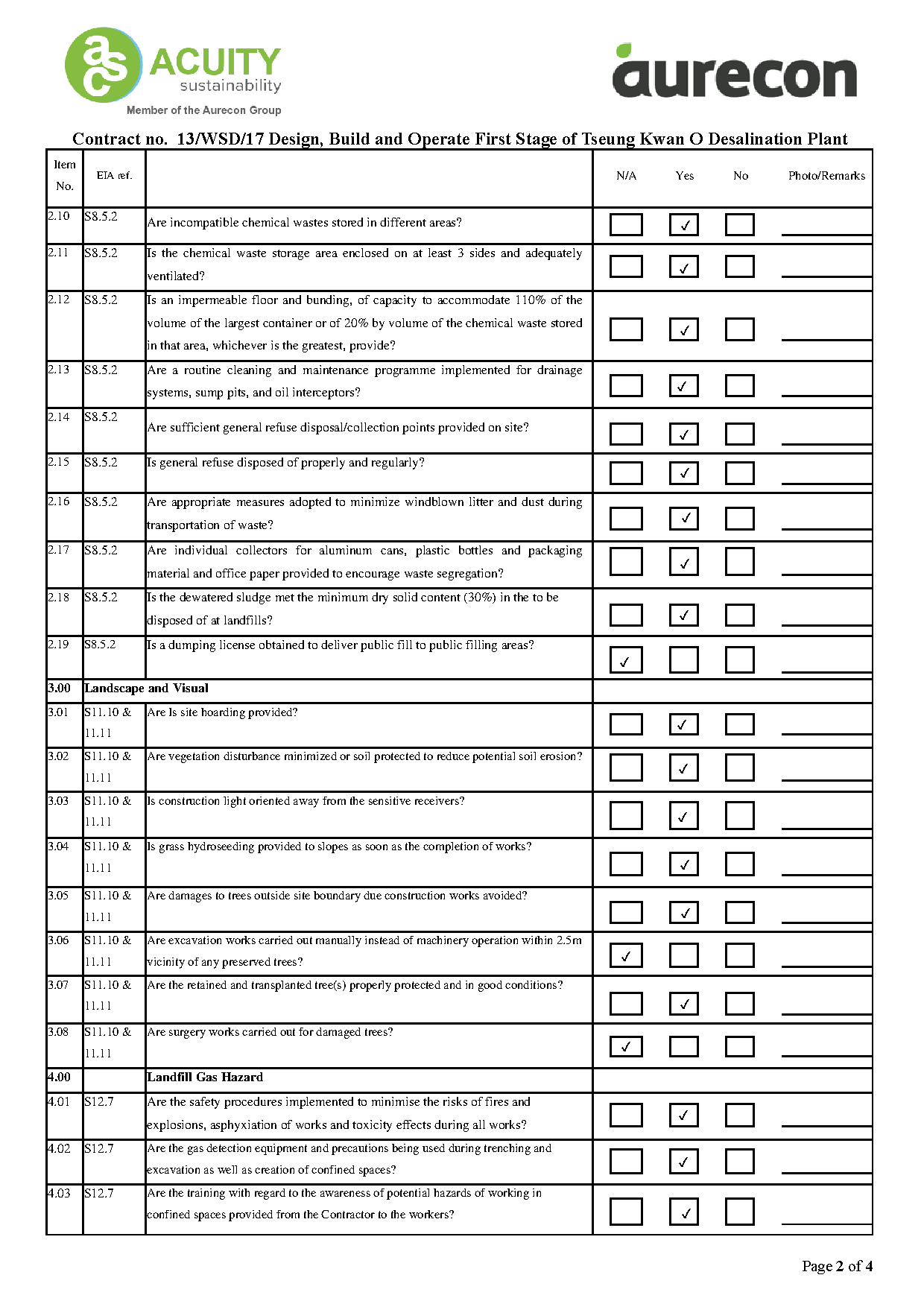
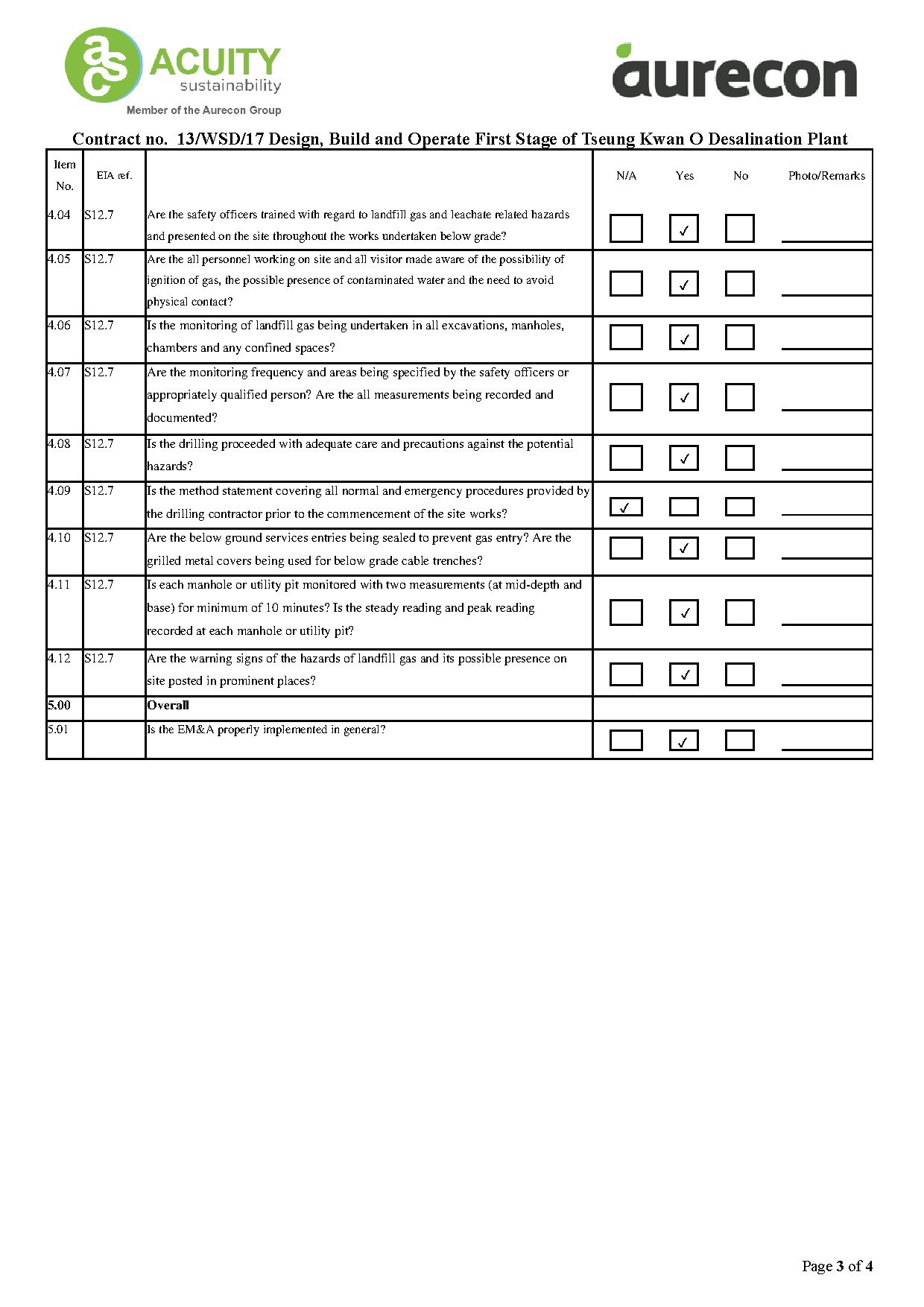
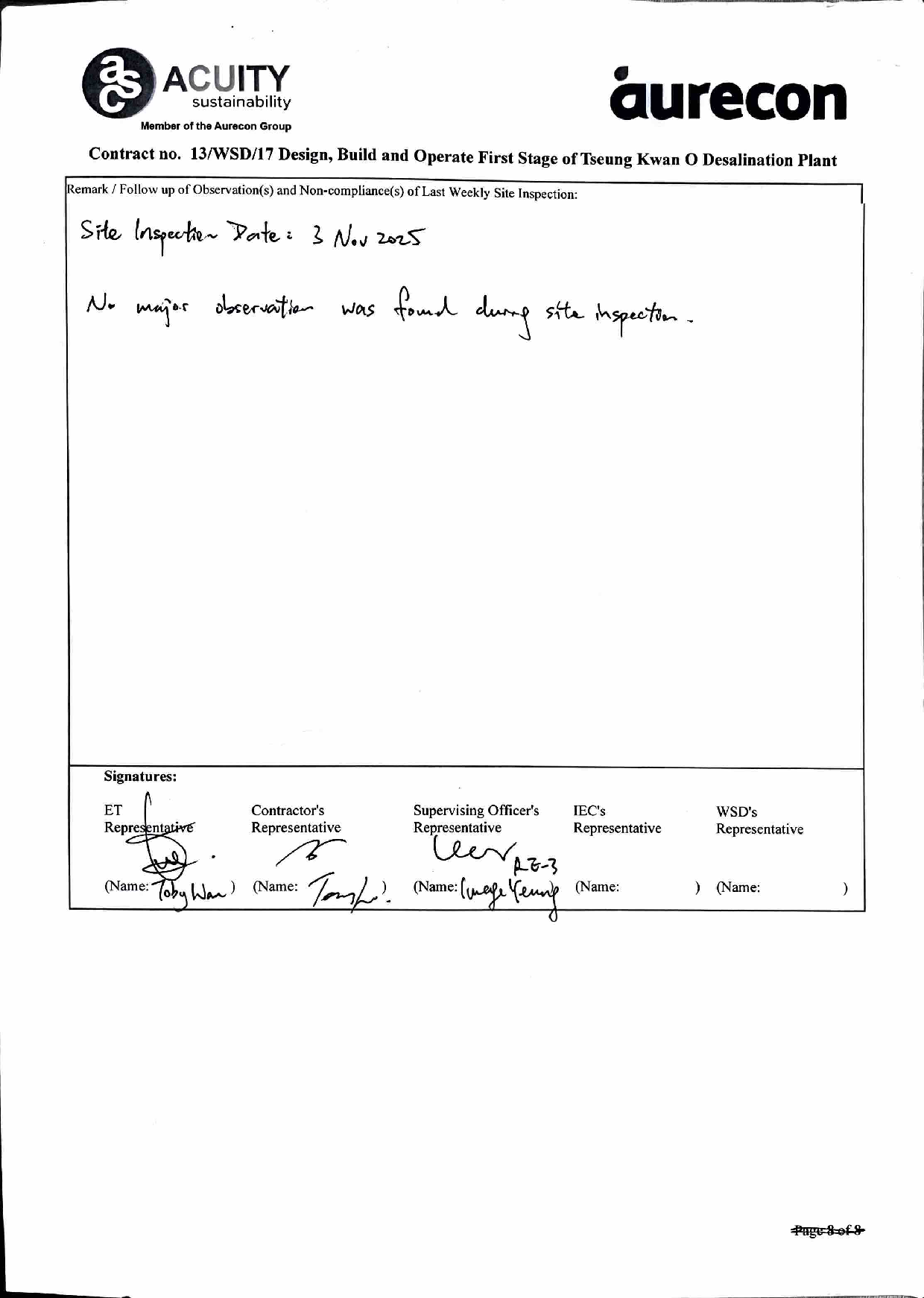
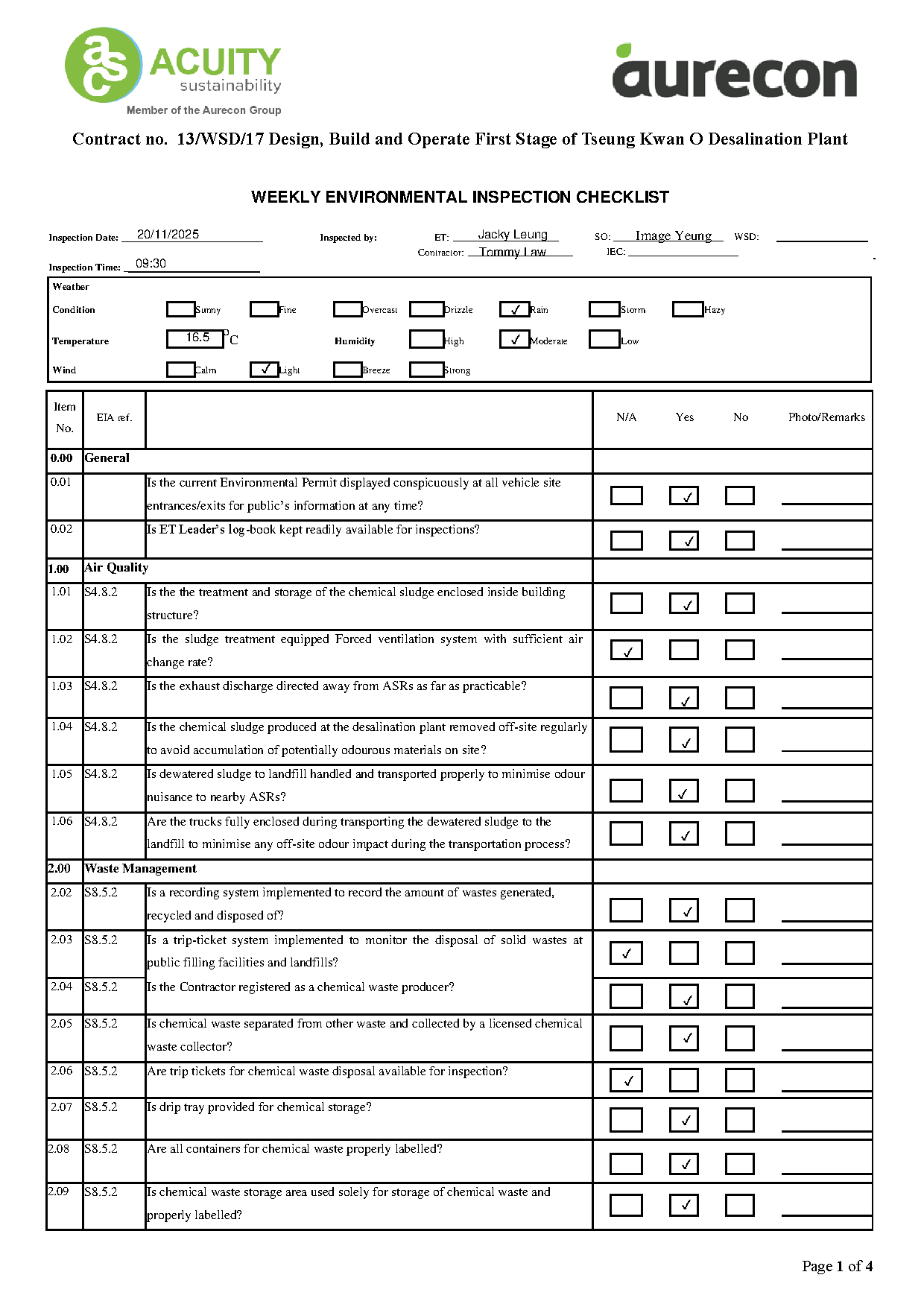
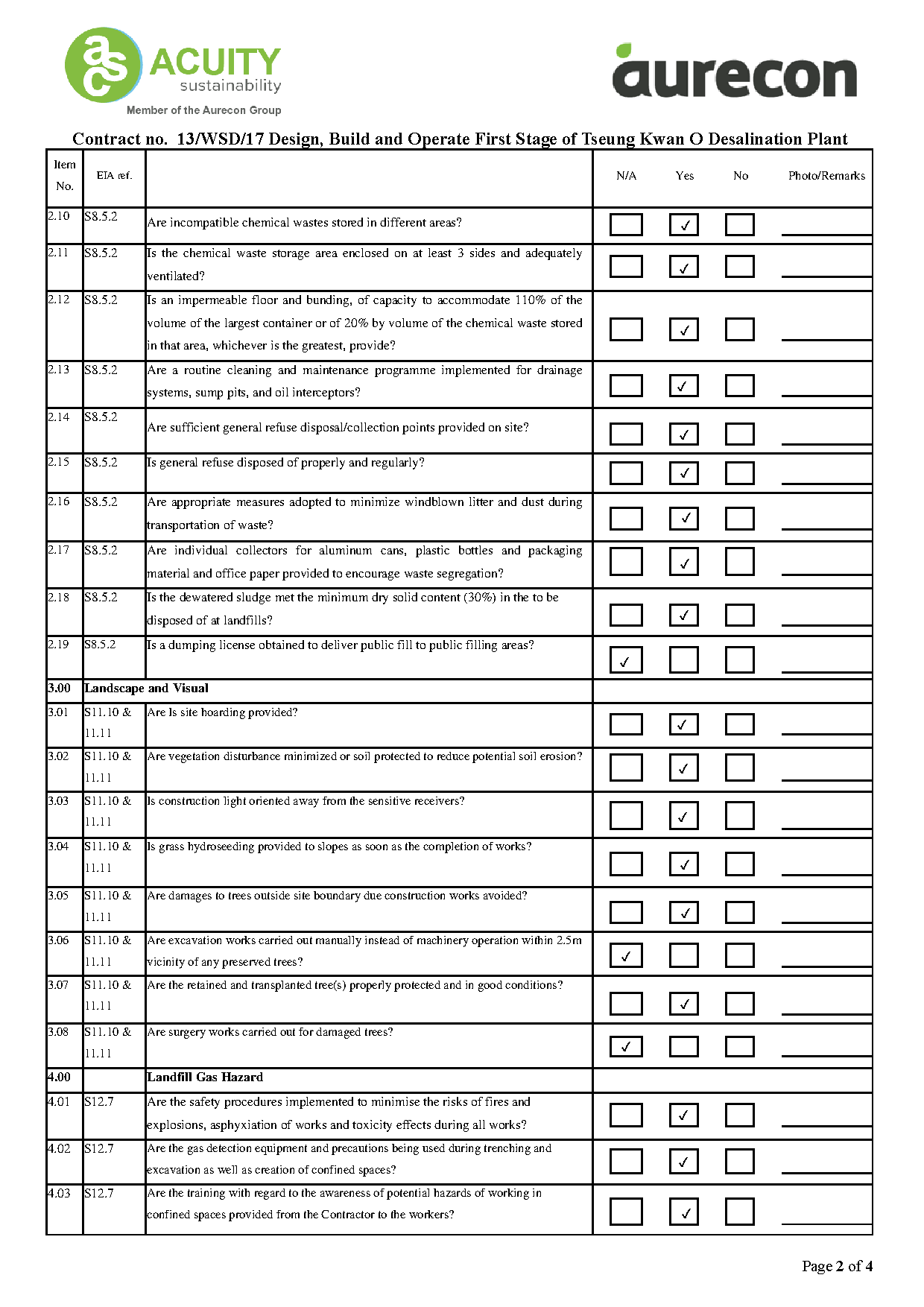
A12. In this reporting period, bi-weekly site inspections were carried out by ET on 3, 20 and 25 November 2025. Joint site inspections of the operation work by ET and IEC were carried out on 25 November 2025 to audit the mitigation measures implementation status.
A13. According to the approved proposal to change the operation phase EM&A programme for the 2nd to 10th year, site inspection will be conducted on a bi-weekly basis starting from 15 August 2025.
Complaint Handling and Prosecution
A14. No environmental complaints, notification of summons and prosecution were received in the reporting period.
Reporting Change
A15. According to the contractor's information, the Anti-scalant dosage commenced on 10 April 2025. The Anti-scalant water quality test was also conducted starting from the same date.
A16. The works of TKODP were substantially completed on 30 June 2024 and the plant commenced the operation phase on 1 July 2024. A Justification of Termination of the EM&A Programme for the Construction Phase was resubmitted to the EPD on 11 August 2025 and approved by the EPD on 15 August 2025.
A proposal to change the operation phase EM&A programme was submitted to the EPD on 11 August 2025 and approved by the EPD on 15 August 2025.
BACKGROUND
1.1. The Acciona Agua, S.A. Trading, Jardine Engineering Corporation, Limited and China State Construction Engineering (Hong Kong) Limited as AJC Joint Venture (AJCJV) is contracted to carry out the Design, Build and Operate First Stage of Tseung Kwan O Desalination Plant (TKODP) under Contract No. 13/WSD/17 (the Contract).
1.2. Aurecon Hong Kong Limited (Aurecon) is commissioned by AJCJV to undertake the Environmental Team (ET) services as required and/or implied, both explicitly and implicitly, in the Environmental Permit (EP), Environmental Impact Assessment Report (EIA Report) (Register No. AEIAR-192/2015) and Environmental Monitoring and Audit Manual (EM&A Manual) for the Contract; and to carry out the Environmental Monitoring and Audit (EM&A) programme in fulfillment of the EIA Report's EM&A requirements and Contract No. 13/WSD/17 Specification requirements.
1.3. Pursuant to the Environmental Impact Assessment Ordinance (EIAO), the Director of Environmental Protection granted the Environmental Permit (No. EP-01/503/2015/B) to Water Supplies Department (WSD); and granted the Further Environmental Permit (No. FEP-01/503/2015/B) to AJCJV for the Contract.
THE REPORTING SCOPE
1.4. This is the 17th Operation Phase Monthly EM&A Report for the Contract which summarizes the key findings of the EM&A programme of the Tseung Kwan O Desalination Plant Operation phase during the reporting period from 1 November to 30 November 2025.
CONTRACT ORGANIZATION
1.5. The Contract Organization structure for Operation Phase is presented in Figure 1.1.
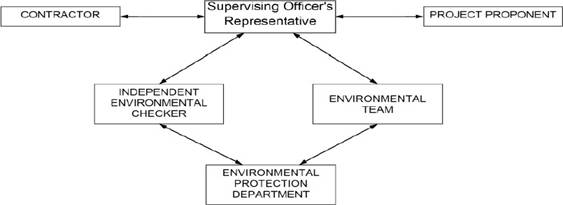
Figure 1.1 Contract Organization Chart
1.6. Contact details of the key personnel are presented in Table 1.1 below:
Party |
Position |
Name |
Telephone no. |
Contract Proponent (Water Supplies Department) |
SE/CM2 |
Milton Law |
2634-3573 |
Supervising Officer (Binnies Hong Kong Limited) |
Project Manager |
Augustine Li |
2608-7671 |
Senior Resident Engineer |
Mason Pau |
6765-4131 |
|
The Jardine Engineering Corporation, Limited, China State Construction Engineering (Hong Kong) Limited and Acciona Agua, S.A. Trading |
Project Manager (Acting) |
Arnes Parra, Victor |
6468-6710 |
Environmental Monitoring Manager |
Brian Kam |
9456-9541 |
|
Environmental Monitoring Manager |
Tommy Law |
6468-1782 |
|
Aurecon Hong Kong Limited |
Environmental Team Leader |
Toby Wan |
9719-5422 |
Lam Environmental Services Limited |
Independent Environmental Checker (IEC) |
Serena Shek |
6149-6683 |
SUMMARY OF OPERATION WORKS
1.7. Details of the major operation activities undertaken in this reporting period are shown below.
1.8. As informed by the Contractor, key activities carried out in this reporting period for the Contract included the followings:
1.9. The key environmental mitigation measures implemented for the Contract in this reporting period associated with the above operation works include:
1.10. Summary of the valid permits, licences, and/or notifications on environmental protection for this Contract is presented in Table 1.2.
Permit/ Licences |
Valid Period |
Status |
Remark |
|
From |
To |
|||
Environmental Permit |
||||
EP-503/2015/B |
Throughout the Contract |
Valid |
-Issued on 3 April 2024 |
|
FEP – 01/503/2015/B |
Throughout the Contract |
Valid |
-Issued on 3 April 2024 |
|
Billing Account for Disposal |
||||
7036276 |
Throughout the Contract |
Valid |
- |
|
Sludge (Special Waste) Disposal (Admission Ticket) |
||||
115399 |
23/08/2025 |
22/02/2026 |
Valid |
- |
Chemical Waste Producer Registration |
||||
5213-839-A2987-01 |
Throughout the Contract |
Valid |
- |
|
Wastewater Discharge Licence (Land and Marine works) |
||||
WT00044188-2023 |
16/06/2023 |
30/06/2028 |
Valid |
EPD advise that we can use the current discharge license for the anti-scalant dosing and discharge limit. They agreed that the report can show the 5PPM is the lowest detection limit. The variation of application was withdrawn on 13 Dec 2024. |
1.11. The status for all environmental aspects is presented in Table 1.3.
Parameters |
Status |
Water Quality |
|
Baseline Monitoring under EM&A Manual |
The baseline water quality monitoring was conducted between 12 May 2020 to 6 Jun 2020. |
Operation phase Marine Water Quality Monitoring |
Completed on 30 June 2025 |
Continuous Monitoring of Effluent Quality Monitoring |
According to the approved proposal to change the operation phase EM&A programme for the 2nd to 10th years, continuous monitoring of effluent quality was discontinued and replaced with effluent water monitoring in compliance with discharge license requirements starting from 15 August 2025. |
Monthly Effluent Quality Monitoring (Discharge License Requirement) |
On-going |
Waste Management |
|
Mitigation Measures in Waste Management Plan |
On-going |
Landfill Gas |
|
Monthly Monitoring for buildings, manholes and utility pits within the Project Site and along the fresh water mains |
According to the approved proposal to change the operation phase EM&A programme for the 2nd to 10th years, landfill gas monitoring will be conducted on a six-month basis starting from August 2025. |
Six-month Basis Monitoring for buildings, manholes and utility pits within the Project Site and along the fresh water mains |
On-going |
Ecology (Coral) |
|
Operation phase Regular Coral Monitoring (Monthly) |
According to the approved proposal to change the operation phase EM&A programme for the 2nd to 10th years, coral monitoring will be conducted on a quarterly basis starting from August 2025. |
Operation phase Regular Coral Monitoring (Quarterly) |
On-going |
Ecology (Fishery) |
|
Operation phase Regular Fishery Monitoring (Seasonally) |
On-going |
Parameters |
Status |
Landscape |
|
Weekly Operation phase Landscape and Visual Site Inspection |
According to the approved proposal to change the operation phase EM&A programme for the 2nd to 10th years, site inspection will be conducted on a bi-weekly basis starting from 15 August 2025. |
Bi-Weekly Operation phase Landscape and Visual Site Inspection |
On-going |
Environmental Audit |
|
Weekly Site Inspection covering Measures of Air Quality, Water Quality, Waste, Ecological Quality, Fisheries, Landscape and Visual |
According to the approved proposal to change the operation phase EM&A programme for the 2nd to 10th years, site inspection will be conducted on a bi-weekly basis starting from 15 August 2025. |
Bi-Weekly Site Inspection covering Measures of Air Quality, Water Quality, Waste, Ecological Quality, Fisheries, Landscape and Visual |
On-going |
1.12. Other than the EM&A work by ET, environmental briefings, trainings, and regular environmental management meetings were conducted, in order to enhance environmental awareness and closely monitor the environmental performance of the contractors.
1.13. The EM&A programme has been implemented in accordance with the recommendations presented in the approved EIA Report and the EM&A Manual. A summary of implementation status of the environmental mitigation measures for the operation phase of the Contract during the reporting period is provided in Appendix B.
2.1. In accordance with the recommendations of the EIA, water quality monitoring is required during operation phase. The following Section provides details of the water quality monitoring to be undertaken by the Environmental Team (ET) to verify the distance of sediment and brine plume dispersion and to identify whether the potential exists for any indirect impacts to occur to ecological sensitive receivers.
2.2. The first-year operation phase marine water quality monitoring was completed on 30 June 2025. No marine water quality monitoring was conducted during the reporting period.
2.3. According to the approved proposal to change the operation phase EM&A programme for the 2nd to 10th years, continuous monitoring of effluent quality was discontinued and replaced with effluent water monitoring in compliance with discharge license requirements starting from 15 August 2025.
WATER DISCHARGE LICENSE (WT00044188-2023 PART 1)
2.4. In accordance with the WT00044188-2023 Part 1, the sampling should be followed the specified frequency, and the parameters of the sample should not be exceeded the limit stated as the water discharge license. Details derived limit levels for water quality are presented in Table 2.1.
Parameters |
Limit |
Monitoring of Effluent Quality |
|
Flow Rate in m3/day |
216841 |
Temperature in °C |
Maximum 40 |
Salinity |
71347 |
SS in mg/L |
13 |
pH |
6-9 |
Iron in mg/L |
0.6 |
Total residual chlorine in mg/L |
0.1 |
Total Inorganic Nitrogen in mg/L |
2 |
Total Phosphorous in mg/L |
1 |
Sodium Metabisulphite in mg/L |
0.5 |
Anti scalant in mg/L* |
2.2 |
*Remark:
1. Anti-scalant water quality testing will only be conducted whenever anti-scalant dosage is adopted.
MONITORING LOCATION
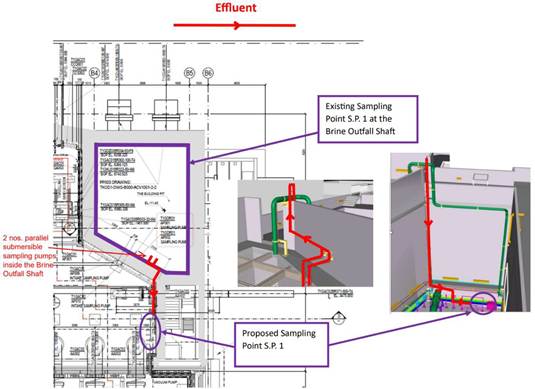
2.5. In accordance with the discharge license, the Monitoring shall be sampling at Brine Outfall Shaft.
MONITORING RESULTS AND OBSERVATIONS
2.6. According to the contractor's information, the Anti-scalant dosage commenced on 10 April 2025. The Anti-scalant water quality test was also conducted starting from the same date.
2.7. The weekly In-situ monitoring was carried out on 4, 11, 18 and 25 November 2025 and the monthly laboratory measurement was carried out on 3 November 2025.
2.8. No exceedance of the results was obtained during the reporting period. The detail results are summarized in Table 2.2, 2.3 and 2.4.
Date |
Determinant |
Results |
Duplicate |
Average |
4 Nov 2025 |
Temp (°C) |
26.6 |
26.8 |
26.7 |
Salinity (ppm) |
58220 |
58200 |
58210 |
|
pH |
8.0 |
7.8 |
8.0 |
|
Total Residual Chlorine (mg/L) |
0.02 |
0.03 |
0.03 |
|
11 Nov 2025 |
Temp (°C) |
26.4 |
26.9 |
26.7 |
Salinity (ppm) |
58870 |
58860 |
58865 |
|
pH |
7.6 |
7.8 |
7.7 |
|
Total Residual Chlorine (mg/L) |
0.03 |
0.04 |
0.04 |
18 Nov 2025 |
Temp (°C) |
25.8 |
25.9 |
25.9 |
Salinity (ppm) |
56730 |
56760 |
56745 |
|
pH |
7.9 |
8.0 |
8.0 |
|
Total Residual Chlorine (mg/L) |
0.02 |
0.04 |
0.03 |
|
25 Nov 2025 |
Temp (°C) |
23.9 |
24.1 |
24 |
Salinity (ppm) |
57120 |
57100 |
57110 |
|
pH |
7.8 |
7.5 |
7.7 |
|
Total Residual Chlorine (mg/L) |
0.03 |
0.05 |
0.04 |
Date |
Determinant |
Results |
3 Nov 2025 |
Flow Rate (m3/day) |
Shown in Table 2.4 |
Suspended Solids (mg/L) |
<2 |
|
Total Inorganic Nitrogen (mg/L) |
0.24 |
|
Total Phosphorous (mg/L) |
<0.01 |
|
Iron (mg/L) |
<0.1 |
|
Sodium Metabisulphite (mg/L)1 |
<2 |
|
ACUMER 4035 (mg/L)2 |
<5 |
Remark:
Date |
Outfall (m3/day) |
1-Nov-25 |
51,600.60 |
2-Nov-25 |
53,309.22 |
3-Nov-25 |
51,608.87 |
4-Nov-25 |
52,888.76 |
5-Nov-25 |
52,638.03 |
6-Nov-25 |
51,764.29 |
7-Nov-25 |
51,628.53 |
8-Nov-25 |
51,788.27 |
9-Nov-25 |
51,793.11 |
10-Nov-25 |
53,496.86 |
11-Nov-25 |
52,857.41 |
12-Nov-25 |
51,414.39 |
13-Nov-25 |
53,858.15 |
14-Nov-25 |
54,116.10 |
15-Nov-25 |
53,917.17 |
16-Nov-25 |
52,193.14 |
17-Nov-25 |
52,502.40 |
18-Nov-25 |
52,364.47 |
19-Nov-25 |
54,771.43 |
20-Nov-25 |
56,015.17 |
21-Nov-25 |
53,615.05 |
22-Nov-25 |
54,206.33 |
23-Nov-25 |
54,772.41 |
24-Nov-25 |
57,433.03 |
25-Nov-25 |
52,320.37 |
26-Nov-25 |
52,717.60 |
27-Nov-25 |
53,957.21 |
28-Nov-25 |
53,242.00 |
29-Nov-25 |
54,350.32 |
30-Nov-25 |
55,061.16 |
3.1. The waste generated from this Contract includes inert construction and demolition (C&D) materials, and non-inert C&D materials. Non-inert C&D materials are made up of general refuse, vegetative wastes and recyclable wastes such as plastics and paper/cardboard packaging waste. Steel materials generated from the Contract are also grouped into non-inert C&D materials as the materials were not disposed of with other inert C&D materials. With reference to relevant handling records and trip tickets of this Contract, the quantities of different types of waste generated in the reporting month are summarized in Table 3.1. Details of cumulative waste management data are presented as a waste flow table in Appendix G.
Reporting Month |
Actual Quantities of Inert C&D Materials Generated Monthly |
Actual Quantities of C&D Wastes Generated Monthly |
|||||||||
Total Quantity Generated |
Hard Rock and Large Broken Concrete |
Reused in the Contract |
Reused in other Projects |
Disposed as Public Fill |
Imported Fill |
Metals |
Paper / cardboard packaging |
Plastics (1) |
Chemical Waste |
Others, e.g., general refuse |
|
(in '000kg) |
(in '000kg) |
(in '000kg) |
(in '000kg) |
(in '000kg) |
(in '000kg) |
(in '000kg) |
(in '000kg) |
(in '000kg) |
(in '000kg) |
(in '000kg) |
|
Nov 2025 |
0.000 |
0.000 |
0.000 |
0.000 |
0.000 |
0.000 |
0.000 |
0.000 |
0.000 |
0.000 |
14.270 |
Notes: (1) Plastics refer to plastic bottles / containers, plastic sheets / foam from packaging material
3.2. No dewater sludge was generated by the operation in the reporting period.
MONITORING REQUIREMENT
4.1. In accordance with Section 11 of the EM&A Manual, monthly monitoring of landfill gas is required for the first year of operation at buildings within the Project Site and consultation zone. Part of the desalination plant and the indicative area of natural slope mitigation works fall within the SENT Landfill Extension Consultation Zone; and part of the 1,200 mm diameter freshwater mains along Wan Po Road falls within the SENT Landfill and SENT Landfill Extension Consultation Zones, TKO Stage II/III Restored Landfill and TKO Stage I Restored Landfill Consultation Zones.
4.2. Routine monitoring is required at buildings within the Project Site and consultation zones. The monitoring frequency will be monthly for the first year of operation.
4.3. For the manholes and utility pits within the Project Site and along the fresh water mains, each manhole/ utility pit should be monitored with two measurements (at mid depth and base). Each measurement should be monitored for a minimum of 10 minutes. A steady reading and peak reading should be recorded at each manhole/ utility pit and for each measurement.
4.4. Monitoring oxygen, methane, carbon dioxide and barometric pressure would be performed monthly during the operation phase.
MONITORING LOCATION
4.5. The area required to be monitored for landfill gas in the reporting period is shown in Figure 4.1, Figure 4.2 and Figure 4.3.
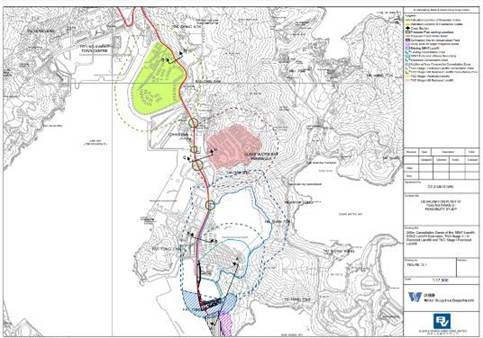
Figure 4.1 Overview of the SENT Extension Consultation Zone and the Contract Site Area

Figure 4.2 Landfill Gas Monitoring Location For Building
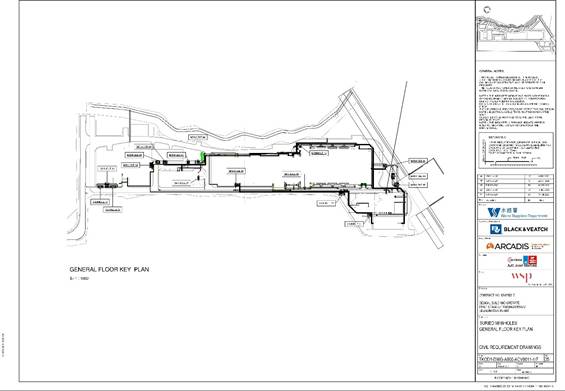
Figure 4.3 Landfill Gas Monitoring Location For Manholes/Pits
MONITORING PARAMETERS
4.6. The landfill gas monitoring parameters and the action and limit level are summarized in Table 4.1.
Table 4.1 Action and Limit Level for Landfill Gas Monitoring Equipment
Parameters |
Action Level |
Limit Level |
Oxygen (O2) |
<19% O2 |
<19% O2 |
Methane (CH4) |
>10% LEL |
>20% LEL |
Carbon Dioxide (CO2) |
>0.5% CO2 |
>1.5% CO2 |
MONITORING EQUIPMENT
methane |
0-100% Lower Explosion Limit (LEL) and 0-100% v/v; |
oxygen |
0-25% V/V; |
carbon dioxide |
0-5% v/v; and |
barometric pressure |
mBar (absolute) |
methane |
>10% LEL; |
oxygen |
<19% |
carbon dioxide |
>0.5% by volume |
barometric pressure |
mBar (absolute) |
4.8. Monitoring equipment used in the reporting period are summarized in Table 4.2. The Landfill Gas monitoring equipment calibration certificate is presented in Appendix E.
Equipment |
Brand and Model |
Calibration Expiry Date |
Portable Gas Detector |
Altair 5X |
22-May-2026 |
MONITORING RESULTS AND OBSERVATIONS
4.9. According to the approved proposal to change the operation phase EM&A programme for the 2nd to 10th year, landfill gas monitoring will be conducted on a six-month basis starting from August 2025.
4.10. In this reporting period, no landfill gas monitoring was conducted during the reporting period.
MONITORING REQUIREMENTS
5.1. In accordance with Section 8.1 of the EM&A Manual, weekly site audit shall be carried out by the ET including checking whether good site practices are being properly implemented by the Contractor and the extent of the works area within the Clear Water Bay Country Park should be checked by the ET during the weekly site audit.
SITE INSPECTION
5.2. Bi-Weekly site audit was carried out by the ET in the reporting month; all plants were observed to be in satisfactory condition in the reporting month.
5.3. If non-compliance were found during the operation phase, the actions in accordance with the Event and Action Plan will be carried out according to Appendix D.
6.1. Under the approval conditions of the EIA Report for the Project, an EM&A programme on coral for the operation phase of the Project is recommended. Pursuant to these EIA approval conditions and Condition 3.1 of the EP and FEP, details of the regular coral monitoring programme have been proposed based on the baseline coral monitoring results in the Report on operation Baseline Coral Monitoring and Regular Coral Monitoring Methodology.
MONITORING LOCATION
6.2. In accordance with Appendix B Section 5.1 of the approved supplementary EM&A Manual, two indirect impact sites (C2 and C3) and one control site (C8) as shown in Figure 6.1 should be monitored during the operation Phase. Operation coral survey should be conducted at the indirect impact and control sites. Ten selected hard coral colonies with similar species should be tagged at each of the control and indirect impact sites before commencement of the operation phase. Tagged hard coral colonies should be monitored in open waters during the operation phase.
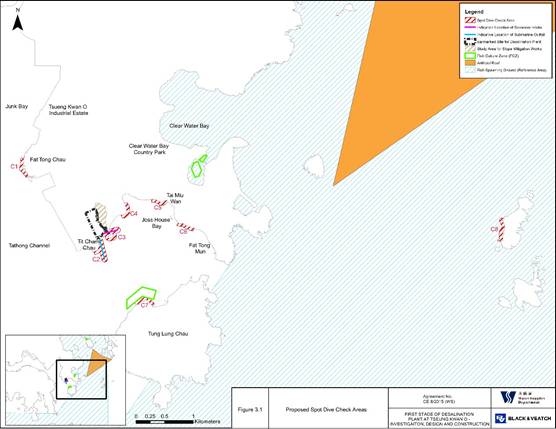
Figure 6.1 Spot Dive Check Areas Two Proposed Indirect Impact Sites (C2 and C3) and one control site (C8) during Operation Phase
ACTION AND LIMIT LEVELS
6.3. The Action and Limit Levels have been set based on the derivation criteria specified in the EM&A Manual. The Action/Limit Levels have been derived and are presented in Table 6.1.
Parameter |
Action Level Definition |
Limit Level Definition |
Mortality |
If during Impact Monitoring a 15% increase in the percentage of partial mortality on the corals occurs at more than 20% of the tagged indirect impact site coral colonies that is not recorded on the tagged corals at the control site, then the Action Level is exceeded |
If during Impact Monitoring a 25% increase in the percentage of partial mortality on the corals occurs at more than 20% of the tagged indirect impact site coral colonies that is not recorded on the tagged corals at the control site, then the Limit Level is exceeded |
Note: If the defined Action Level or Limit Level for coral monitoring is exceeded, the actions as set out in
Appendix D, Table D3 will be implemented.
6.4. If non-compliance were found during the operation works, the actions in accordance with the Event and Action Plan will be carried out according to Appendix D.
MONITORING FREQUENCY
6.5. Operation phase coral monitoring shall be monitored once per month as the requirement of the first year of operational phase.
MONITORING RESULT AND OBSERVATION
6.6. Coral monitoring was conducted on 26 November 2025. A total of 30 tagged coral colonies (10 at control site and 20 and two indirect impact sites) were monitored. 3 coral colonies with mortality in Site C3 were recorded, all other coral colonies were good in general. Detailed Coral monitoring report is presented in Appendix H.
6.7. According to the approved proposal to change the operation phase EM&A programme for the 2nd to 10th year, coral monitoring will be conducted on a quarterly basis starting from August 2025.
7.1. The purpose of the operation phase regular fisheries monitoring programme is to monitor the potential impacts on fisheries resources in the vicinity of the project site. Apart from the regular fisheries monitoring programme, a water quality monitoring programme in addition to the water quality monitoring programme in the approved EM&A Manual is also described in Section 2.4 to (i) provide supplementary information in the interpretation of the findings of the fisheries monitoring and (ii) assist the monitoring of the potential impact on the Tung Lung Chau Fish Culture Zone (FCZ) in Joss House Bay.
MONITORING LOCATION
7.2. In accordance with Section 2.3 of the approved Methodology Paper on Regular Fisheries Monitoring, it is recommended to set up six (6) fisheries monitoring locations in Joss House Bay and its vicinity to monitor the fisheries resources.
7.3. Two (2) sampling locations are set up in close proximity of the direct footprint of the proposed submarine utilities around TKO Area 137. These sampling locations represent the potential Project impact zones (i.e. areas at and in close proximity to the footprint of the proposed submarine utilities that will be directly affected by the Project works).
7.4. Two (2) gradient locations are proposed between the proposed submarine utilities and Tung Lung Chau FCZ to assist in the interpretation and identification of any potential fisheries impact in the vicinity of the FCZ.
7.5. Two (2) reference locations are proposed in the outer Joss House Bay between the waters of Tung Lung Chau and Fat Tong Mun. These reference locations are further away and will not be affected by the Project discharge (based on the EIA prediction) and will serve as control stations. Any significant fisheries impact identified at the reference locations should be caused by other natural factors or non-Project activities. The trends of fisheries conditions recorded in the reference locations will be used to assist in the interpretation of the trends of fisheries impact identified in the impact and gradient locations.
7.6. The coordinates of the proposed monitoring locations are shown in Figure 7.1.
MONITORING FREQUENCY
7.7. Operation phase fishery monitoring shall be carried out 2 times in wet season (April to October) and 2 times in dry season (December to March) to examine the following:
MONITORING RESULT AND OBSERVATION
7.8. Operation phase fishery monitoring for wet season 2025 was carried out on 16 and 23 August 2025. Details of the survey report were included in the October Monthly Report.

Figure 7.1 Monitoring Location of Regular Fishery Monitoring during Operation Phase
8.1. The Environmental Complaint Handling Procedure is shown in below Figure 9.1:
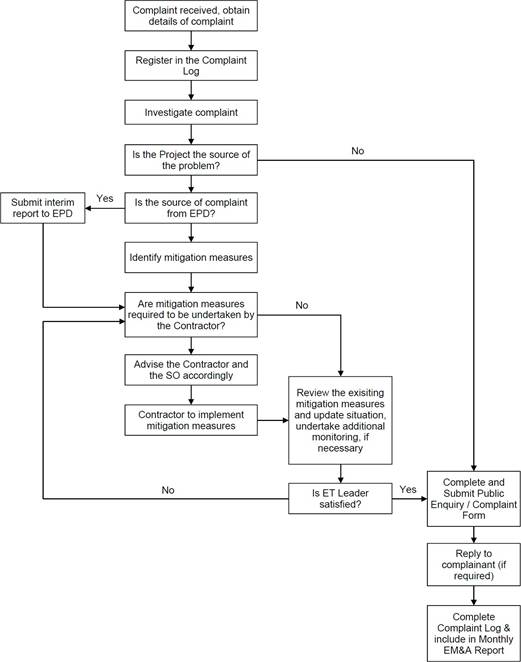
Figure 9.1 Environmental Complaint Handling Procedures
8.2. The first-year operation phase marine water quality monitoring was completed on 30 June 2025. No marine water quality monitoring was conducted during the reporting period.
8.3. Effluent Quality was conducted sampling point in the reporting month. No exceedance of the results was obtained during the reporting period.
8.4. Coral monitoring was conducted on 26 November 2025. A total of 30 tagged coral colonies (10 at control site and 20 and two indirect impact sites) were monitored. 3 coral colonies with mortality in Site C3 were recorded, all other coral colonies were good in general.
8.5. Operation phase fishery monitoring for wet season 2025 was carried out on 16 and 23 August 2025. Details of the survey report were included in the October Monthly Report.
8.6. No landfill gas monitoring was conducted during the reporting period.
8.7. No environmental complaint, notification of summons and prosecution Statistics on complaint and notification of summons and prosecution are summarized in Appendix J.
9.1. According to the approved proposal to change the operation phase EM&A programme for the 2nd to 10th years, site inspection will be conducted on a bi-weekly basis starting from 15 August 2025.
9.2. Site inspections were carried out to monitor the implementation of proper environmental pollution control and mitigation measures under the Contract. In the reporting period, site inspections were carried out on 3 20, and 25 November 2025 at the site portions listed in Table 9.1 below.
Date |
Inspected Site Portion |
Time |
3 November 2025 |
TKO Area 137 |
09:30 – 10:30 |
20 November 2025 |
TKO Area 137 |
09:30 – 10:30 |
25 November 2025 |
TKO Area 137 |
09:30 – 10:30 |
9.3. Joint site inspections with IEC were carried out on 25 November 2025.
9.4. No Environmental deficiencies were observed during site inspection. The site inspections during the reporting period are summarized in Table 9.2.
Date |
Environmental Observations |
Follow-up Status |
3 November 2025 |
No major environmental deficiency was observed. |
N/A |
20 November 2025 |
No major environmental deficiency was observed. |
N/A |
25 November 2025 |
No major environmental deficiency was observed. |
N/A |
9.5. According to the EIA Study Report, Environmental Permit, contract documents and EM&A Manual, the mitigation measures detailed in the documents should be implemented as much as practical during the reporting period. An updated Implementation Status of Environmental Mitigation Measures (EMIS) is provided in Appendix B. Site inspection proforma of the reporting period is provided in Appendix I.
10.1. Works to be undertaken in the next reporting month are:
10.2. The major environmental impacts brought by the above operation works include:
10.3. The key environmental mitigation measures implemented for the Contract in this reporting period associated with the above operation works include:
11.1. This is the 17th Monthly EM&A Report for the Project which summarizes the key findings of the EM&A programme during the reporting period from 1 October to 31 October 2025, in accordance with the EM&A Manual and the requirement under FEP-01/503/2015/B.
11.2. The first-year operation phase marine water quality monitoring was completed on 30 June 2025. No marine water quality monitoring was conducted during the reporting period.
11.3. Effluent Quality was conducted sampling point in the reporting month. No exceedance of the results was obtained during the reporting period.
11.4. Coral monitoring was conducted on 26 November 2025. A total of 30 tagged coral colonies (10 at control site and 20 and two indirect impact sites) were monitored. 3 coral colonies with mortality in Site C3 were recorded, all other coral colonies were good in general.
11.5. Operation phase fishery monitoring for wet season 2025 was carried out on 16 and 23 August 2025. Details of the survey report were included in the October Monthly Report.
11.6. No landfill gas monitoring was conducted during the reporting period.
11.7. Environmental site inspections were conducted during the reporting period. Observations and reminders were reported during the site inspections. All items are rectified within the reporting period. The environmental performance of the project was therefore considered satisfactory.
11.8. No environmental complaints, notification of summons and prosecution was received in the reporting period.
11.9. The ET will keep track on the operation works to confirm compliance of environmental requirements and the proper implementation of all necessary mitigation measures.
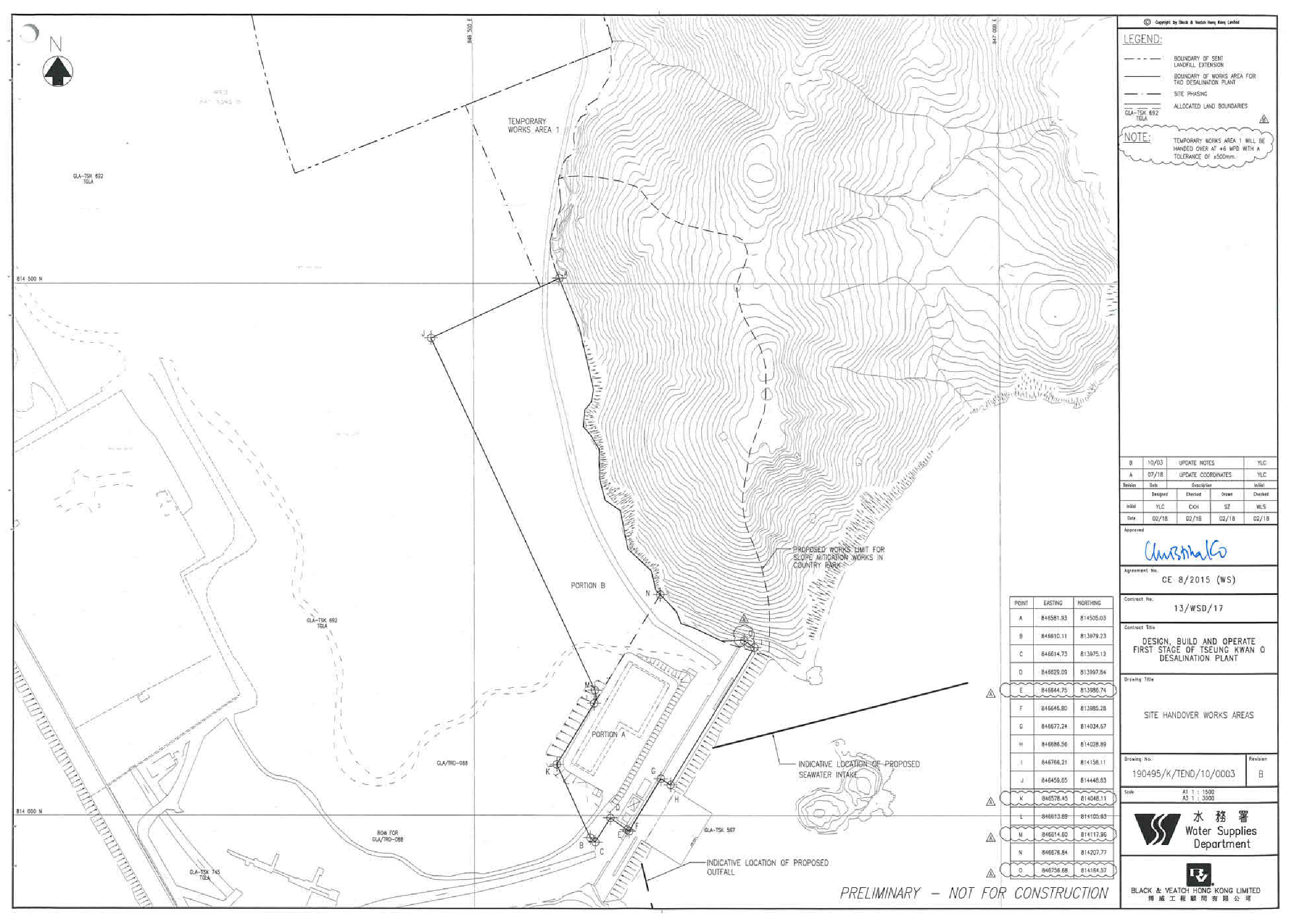
Appendix A
Overview of Desalination Plant in Tseung Kwan O
Appendix B
Summary of Implementation Status of Environmental Mitigation
EIA Reference |
Recommended Environmental Protection Measures/ Mitigation Measures |
Objectives of the recommended measures & main concerns to address |
Implementation Agent |
Implementation Stage |
Implementation status |
Relevant Legislation & Guidelines |
||
D |
C |
O |
||||||
Air Quality |
|
|||||||
S4.8.1 |
Ultra-low-sulphur diesel (ULSD) will be used for all construction plant on-site, as defined as diesel fuel containing not more than 0.005% sulphur by weight) as stipulated in Environment, Transport and Works Bureau Technical Circular (ETWB-TC(W)) No 19/2005 on Environmental Management on Construction Sites. |
Land site/ During construction/ During Operation |
Contractor(s) |
|
ü |
ü |
Implemented |
Environment, Transport and Works Bureau Technical Circular (ETWB- TC(W)) No 19/2005 on Environmental Management on Construction Sites |
Water Quality |
||||||||
S6.9 and S6.12 |
The sterilization water should be dechlorinated with total residual chlorine (TRC) level below 1 mg/L before discharge to public sewer. In situ testing of TRC should also be conducted for the discharge of chlorinated water for pipeline disinfection to ensure sufficient dechlorination before discharge to public sewer. |
Sterilization of water mains prior to commissioning |
Contractor(s) |
|
ü |
ü |
Implemented |
Technical Memorandum for Effluents Discharged into Drainage and Sewerage Systems Inland and Coastal Waters |
S6.9 |
The cleaning and flushing water should also be treated and desilted to the relevant discharge requirement stipulated in TM-DSS before discharging. |
Sterilization of water mains prior to commissioning |
Contractor(s) |
|
ü |
ü |
Implemented |
|
S6.9 |
Site drainage should be well maintained, and good construction practices should be observed to ensure that oil, fuels, solvents, and other chemicals are managed, stored and handled properly and do not enter the nearby water streams. |
Land site & drainage/ During construction/ During operation |
Contractor(s) |
|
ü |
ü |
Implemented |
- |
Waste Management |
||||||||
S8.5 |
Provision of sufficient waste disposal points and regular collection for disposal. |
All area/ During construction/ During operation |
Contractor(s) |
|
ü |
ü |
Implemented |
DEVB TC(W) No. 8/2010, Enhanced Specification for Site Cleanliness and Tidiness. |
S8.5 |
Chemical waste container shall be suitable for the substance they are holding, resistant to corrosion, maintained in a good condition, and securely closed. |
All area/ During construction/ During operation |
Contractor(s)/ WSD |
|
ü |
ü |
Implemented |
Waste Disposal (Chemical Waste) (General) Regulation; Code of Practice on the Packaging, Handling and Storage of Chemical Wastes |
S8.5 |
Chemical waste container shall have a capacity of less than 450 L unless the specifications have been approved by the EPD. |
All area/ During construction/ During operation |
Contractor(s)/ WSD |
|
ü |
ü |
Implemented |
|
S8.5 |
A label in English and Chinese shall be displayed on the chemical container in accordance with instructions prescribed in Schedule 2 of the Regulations. |
All area/ During construction/ During operation |
Contractor(s)/ WSD |
|
ü |
ü |
Implemented |
|
EIA Reference |
Recommended Environmental Protection Measures/ Mitigation Measures |
Objectives of the recommended measures & main concerns to address |
Implementation Agent |
Implementation Stage |
Implementation status |
Relevant Legislation & Guidelines |
||
D |
C |
O |
||||||
S8.5 |
Storage areas for chemical waste shall be enclosed on at least 3 sides. |
All area/ During construction/ During operation |
Contractor(s)/ WSD |
|
ü |
ü |
Implemented |
|
S8.5 |
Storage areas for chemical waste shall have an impermeable floor and bunding, of capacity to accommodate 110% of the volume of the largest container or 20% by volume of the chemical waste stored in that area, whichever is the greatest. |
All area/ During construction/ During operation |
Contractor(s)/ WSD |
|
ü |
ü |
Implemented |
|
S8.5 |
Storage areas for chemical waste shall have adequate ventilation. |
All area/ During construction/ During operation |
Contractor(s)/ WSD |
|
ü |
ü |
Implemented |
|
S8.5 |
Storage areas for chemical waste shall be covered to prevent rainfall entering (water collected within the bund must be tested and disposed of as chemical waste, if necessary). |
All area/ During construction/ During operation |
Contractor(s)/ WSD |
|
ü |
ü |
Implemented |
|
S8.5 |
Storage areas for chemical waste shall be arranged so that incompatible materials are appropriately separated. |
All area/ During construction/ During operation |
Contractor(s)/ WSD |
|
ü |
ü |
Implemented |
|
S8.5 |
General refuse will be stored in enclosed bins or compaction units separately from construction and chemical wastes. |
All area/ During construction/ During operation |
Contractor(s)/ WSD |
|
ü |
ü |
Implemented after reminder |
|
S8.5 |
Adequate number of waste containers will be provided to avoid over-spillage of waste. |
All area/ During construction/ During operation |
Contractor(s)/ WSD |
|
ü |
ü |
Implemented |
DEVB TC(W) No. 8/2010 Enhanced Specification for Site Cleanliness and Tidiness. |
S8.5 |
A reputable waste collector will be employed by the Contractor to remove general refuse from the site, separately from construction and chemical wastes, on a daily basis to minimize odour, pest and litter impacts. |
All area/ During construction/ During operation |
Contractor(s)/ WSD |
|
ü |
ü |
Implemented |
- |
S8.5 |
Recycling bins will be provided at strategic locations within the Site to facilitate recovery of recyclable materials (including aluminum can, wastepaper, glass bottles and plastic bottles) from the Site. Materials recovered will be sold for recycling. |
All area/ During construction/ During operation |
Contractor(s)/ WSD |
|
ü |
ü |
Implemented |
- |
Landscape & Visual |
||||||||
S11.10 & 11.11 |
The construction area and area allowed for temporary structures, such as the contractor's office, will be minimized to a practical minimum. (MM1) |
All area/ Detailed design/ During construction/ During operation |
WSD/ Contractor(s) |
ü |
ü |
ü |
Implemented |
- |
EIA Reference |
Recommended Environmental Protection Measures/ Mitigation Measures |
Objectives of the recommended measures & main concerns to address |
Implementation Agent |
Implementation Stage |
Implementation status |
Relevant Legislation & Guidelines |
||
D |
C |
O |
||||||
S11.10 & 11.11 |
At the detailed design stage, the design team will seek to minimize the landscape footprint of the Project and above ground facilities, while satisfying all other requirements. (MM2) |
All area/ Detailed design/ During construction/ During operation |
WSD/ Contractor(s) |
ü |
ü |
ü |
Implemented |
- |
S11.10 & 11.11 |
Design principles will be adopted to take into account the surrounding area, particularly Clear Water Bay Country Park behind and the nearby waterfront, with due consideration given to:
native shrubs where feasible, to reduce their visual impact and blend them into the surrounding landscape. (MM3) |
All area/ Detailed design/ During construction/ During operation |
WSD/ Contractor(s) |
ü |
ü |
ü |
Implemented |
- |
S11.10 & 11.11 |
All trees within the Project Site or the potential slope mitigation works area will be carefully protected during construction according to DEVB TCW No. 10/2013 – Tree Preservation (MM4) |
All area/ Detailed design/ During construction/ During operation |
WSD/ Contractor(s) |
ü |
ü |
ü |
Implemented |
ETWB TCW No. 3/2006 - Tree Preservation. |
S11.10 & 11.11 |
No tree within the Country Park will be felled. Trees within the Site unavoidably affected by the works will be transplanted where necessary and practical. For trees that need to be felled, compensatory planting will be provided to the satisfaction of relevant Government departments. A compensatory tree planting proposal including locations of tree compensation will be submitted to seek relevant government department's approval, in accordance with DEVB TC(W) No. 10/2013. (MM5) |
All area/ Detailed design/ During construction/ During operation |
WSD/ Contractor(s) |
ü |
ü |
ü |
Implemented |
DEVB TC(W) No. 10/2013 |
S11.10 & 11.11 |
Any slope mitigation works necessary to address natural terrain hazards, will be minimized to minimize any potential environmental impact to the Country Park e.g. soil nailing and rock stabilization will aim to avoid existing trees e.g. should any restoration of vegetation be necessary, the best planting matrix with native species will be established, with the aim of resembling the existing vegetation. (MM6) |
All area/ Detailed design/ During construction/ During operation |
WSD/ Contractor(s) |
ü |
ü |
ü |
Implemented |
|
S11.10 & 11.11 |
Dredging works for the installation of intake structures and outfall diffusers should be minimized to avoid or reduce any potential environmental impacts to as low as reasonably practicable (ALARP). The intake and outfall structures (e.g. intake openings and diffuser heads) will be prefabricated and transferred to site for |
All area/ Detailed design/ During construction/ During operation |
WSD/ Contractor(s) |
ü |
ü |
ü |
Implemented |
|
EIA Reference |
Recommended Environmental Protection Measures/ Mitigation Measures |
Objectives of the recommended measures & main concerns to address |
Implementation Agent |
Implementation Stage |
Implementation status |
Relevant Legislation & Guidelines |
||
D |
C |
O |
||||||
|
installation. (MM7) |
|
|
|
|
|
|
|
S11.10 & 11.11 |
All night-time lighting will be reduced to a practical minimum both in terms of number of level and will be hooded and directional. (MM8) units and lux level and will be hooded and directional. (MM8) |
All area/ Detailed design/ During construction/ During operation |
WSD/ Contractor(s) |
ü |
ü |
ü |
Implemented |
- |
Landfill Gas Hazard |
||||||||
S12.7 |
During all works, safety procedures should be implemented to minimize the risks of fires and explosions, asphyxiation of workers and toxicity effects resulting from contact with contaminated soil and groundwater. |
All area/ Detailed design/ During construction/operation |
Contractor(s) |
ü |
ü |
ü |
Implemented |
- |
S12.7 |
During trenching and excavation as well as creation of confined spaces at near to or below ground level, precautions should be clearly laid down and rigidly Gas detection equipment and appropriate breathing apparatus should be available and used when entering confined spaces or trenches deeper than 1 meter. |
All area/ Detailed design/ During construction/operation |
Contractor(s) |
ü |
ü |
ü |
Implemented |
|
S12.7 |
The Contractor should make the workers are aware of potential hazards of working in confined spaces (any chamber, manhole or culvert which is large enough to permit access to personnel). Such work in confined spaces is controlled by the Factories and Industrial Undertakings (Confined Spaces) Regulations of the Factories and Industrial Undertakings Ordinance. Following the Safety Guide to Working in Confined Spaces ensures compliance with the above regulations. |
All area/ Detailed design/ During construction/operation |
Contractor(s) |
ü |
ü |
ü |
Implemented |
|
S12.7 |
Safety officers, specifically trained with regard to landfill gas and leachate related hazards and the appropriate actions to take in adverse circumstances, should be present on the site throughout the works, in particular, when works are undertaken below grade. |
All area/ Detailed design/ During construction/operation |
Contractor(s) |
ü |
ü |
ü |
Implemented |
|
S12.7 |
All personnel who work on site and all visitors to the site should be made aware of the possibility of ignition of gas in the vicinity of the works, the possible presence of contaminated water and the need to avoid physical contact with it. |
All area/ Detailed design/ During construction/operation |
Contractor(s) |
ü |
ü |
ü |
Implemented |
|
S12.7 |
Monitoring for landfill gas should be undertaken in all excavations, manholes, chambers (particularly during pipe jacking) and any confined spaces through the use of an intrinsically safe portable instrument, appropriately calibrated and capable of measuring the concentrations of methane. carbon dioxide and oxygen. |
All area/ Detailed design/ During construction/operation |
Contractor(s) |
ü |
ü |
ü |
Implemented |
|
S12.7 |
Monitoring frequency and areas to be monitored should be specified prior to commencement of groundwork, either by the Safety Officer, or by an appropriately qualified person. All measurements should be recorded and documented. |
All area/ Detailed design/ During construction/operation |
Contractor(s) |
ü |
ü |
ü |
Implemented |
|
EIA Reference |
Recommended Environmental Protection Measures/ Mitigation Measures |
Objectives of the recommended measures & main concerns to address |
Implementation Agent |
Implementation Stage |
Implementation status |
Relevant Legislation & Guidelines |
||
D |
C |
O |
||||||
S12.7 |
Proceed drilling with adequate care and precautions against the potential hazards which may be encountered. |
All area/ Detailed design/ During construction/operation |
Contractor(s) |
ü |
ü |
ü |
Implemented |
|
S12.7 |
Prior to the commencement of the site works, the drilling contractor should devise a 'method-of- working' statement covering all normal and emergency procedures (including but not limited to number of operatives, experience and special skills of operatives, normal method of operations, emergency procedures, supervisors responsibilities, storage and use of safety equipment, safety procedures and signs, barriers and guarding). The site supervisor and all operatives must be familiar with this statement. |
All area/ During construction/operation |
Contractor(s) |
ü |
ü |
ü |
Implemented |
|
S12.7 |
Where below ground service entries are necessary to the Incoming Switchgear Room, 132 kV Substation and Chlorine Store (I) and (II), the entry point should be sealed to prevent gas entry. In addition, any below grade cable trenches entering the Incoming Switchgear Room and 132 kV Substation can become the pathway for landfill gas and hence grilled metal covers should be used. |
All area/ Detailed design/ During construction/operation |
Contractor(s) |
ü |
ü |
ü |
Implemented |
|
S12.7 |
It is recommended regular landfill gas monitoring should be carried out at the Incoming Switchgear Room, 132 kV Substation and Chlorine Store (I) and (II). The monitoring frequency will be monthly for the first year of operation. If the monitoring results show no sign of landfill gas migration, reduce the monitoring frequency to once every six months. |
All area/ Detailed design/ During construction/operation |
Contractor(s) |
ü |
ü |
ü |
Implemented |
|
S12.7 |
The manholes and utility pits within the Project Site and along the fresh water mains. Each manhole/ utility pit should be monitored with two measurements (at mid depth and base). Each measurement should be monitored for a minimum of 10 minutes. A steady reading and peak reading should be recorded at each manhole/ utility pit and for each measurement. The need for venting the manhole/ utility pit and further monitoring will be reviewed after the initial monitoring. |
All area/ Detailed design/ During construction/operation |
Contractor(s) |
ü |
ü |
ü |
Implemented |
|
S12.7 |
All construction, operation and maintenance personnel working on-site as well as visitors should be made aware of the hazards of landfill gas and its possible presence on-site. This should be achieved through a combination of posting warning signs in prominent places and also by access to detailed information on landfill gas hazards and the designs and procedural means by which these hazards are being minimized on-site. |
All area/ Detailed design/ During construction/operation |
Contractor(s) |
ü |
ü |
ü |
Implemented |
|
Note: D – Design stage C – Construction O – Operation
Appendix C
Impact Monitoring Schedule
Contract No. 13/WSD/17
Design, Build and Operate First Stage of Tseung Kwan O Desalination Plant
 2nd Year Operation Monitoring Programme
Monitoring |
Jul-25 |
Aug-25 |
Sep-25 |
Oct-25 |
Nov-25 |
Dec-25 |
Jan-26 |
Feb-26 |
Mar-26 |
Apr-26 |
May-26 |
Jun-26 |
Effluent Quality (2) |
✔ |
✔ |
✔ |
✔ |
✔ |
✔ |
✔ |
✔ |
✔ |
✔ |
✔ |
✔ |
Landfill Gas (3) |
✔ |
✔ |
|
|
|
|
|
✔ |
|
|
|
|
Coral (4) |
✔ |
✔ |
|
|
✔ |
|
|
✔ |
|
|
✔ |
|
Fishery (5) |
|
✔ |
|
|
|
|
|
✔ |
|
|
|
|
Remark:
Appendix D
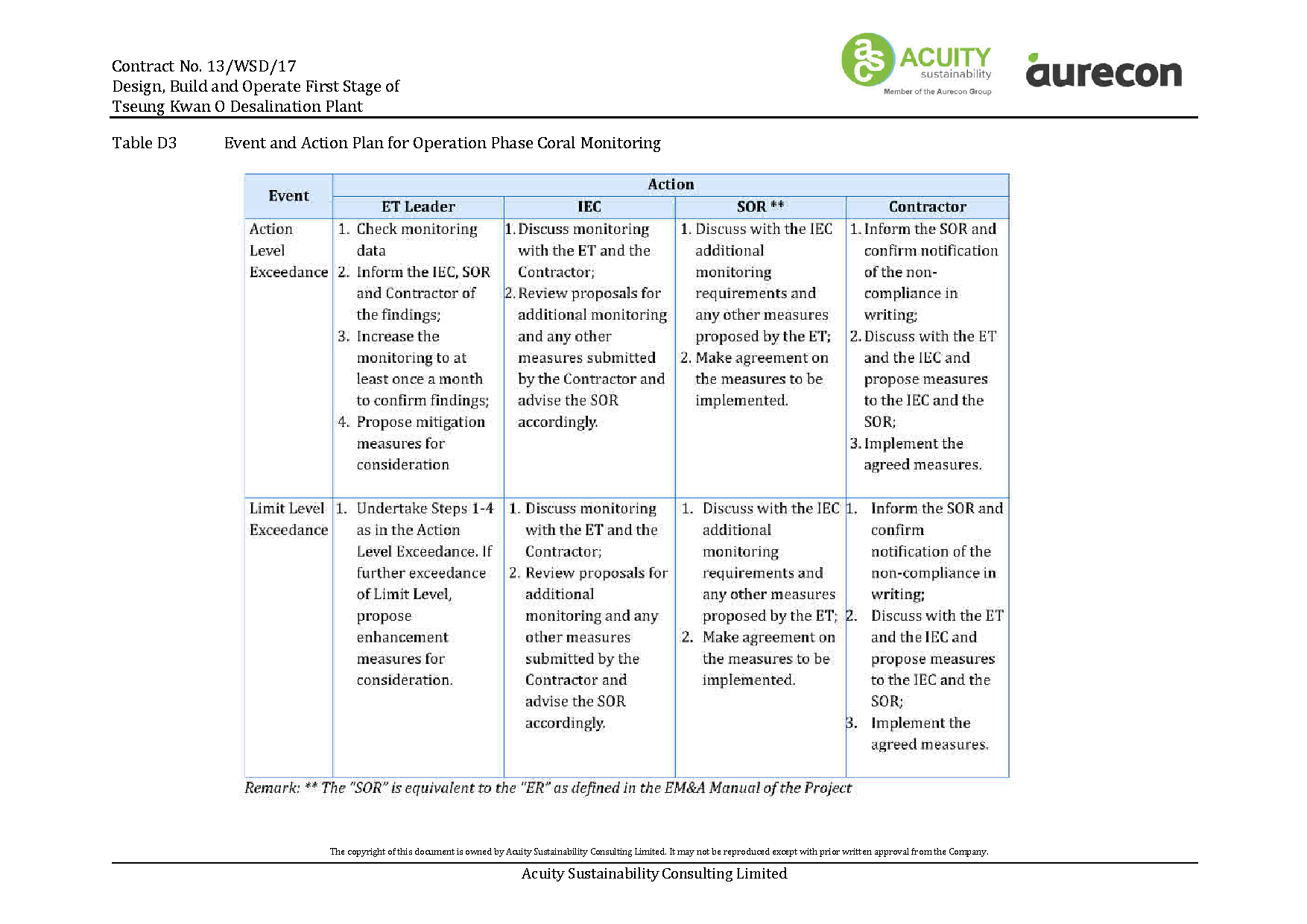
Event / Action Plan
Appendix E
Landfill Gas Equipment Calibration Certification
(Not Used)
Appendix F
Landfill Gas Monitoring Data
(Not Used)
Appendix H
Ecology Survey Report
Parameter |
Action Level Definition |
Limit Level Definition |
Mortality |
If during Impact Monitoring a 15% increase in the percentage of partial mortality on the corals occurs at more than 20% of the tagged indirect impact site coral colonies that is not recorded on the tagged corals at the control site, then the Action Level is exceeded |
If during Impact Monitoring a 25% increase in the percentage of partial mortality on the corals occurs at more than 20% of the tagged indirect impact site coral colonies that is not recorded on the tagged corals at the control site, then the Limit Level is exceeded |
Note: If the defined Action Level or Limit Level for coral monitoring is exceeded, the actions as set out in Table 5-4 will be implemented.
Event |
Action |
|||
ET Leader |
IEC |
SOR |
Contractor |
|
Action Level Exceedance |
Contractor of the findings;
consideration |
|
additional monitoring requirements and any other measures proposed by the ET;
implemented. |
compliance in writing;
|
Remark: ** The "SOR" is equivalent to the "ER" as defined in the EM&A Manual of the Project
Date |
Condition |
Average Underwater Visibility |
26 November 2025 |
|
0.5 – 1 m |
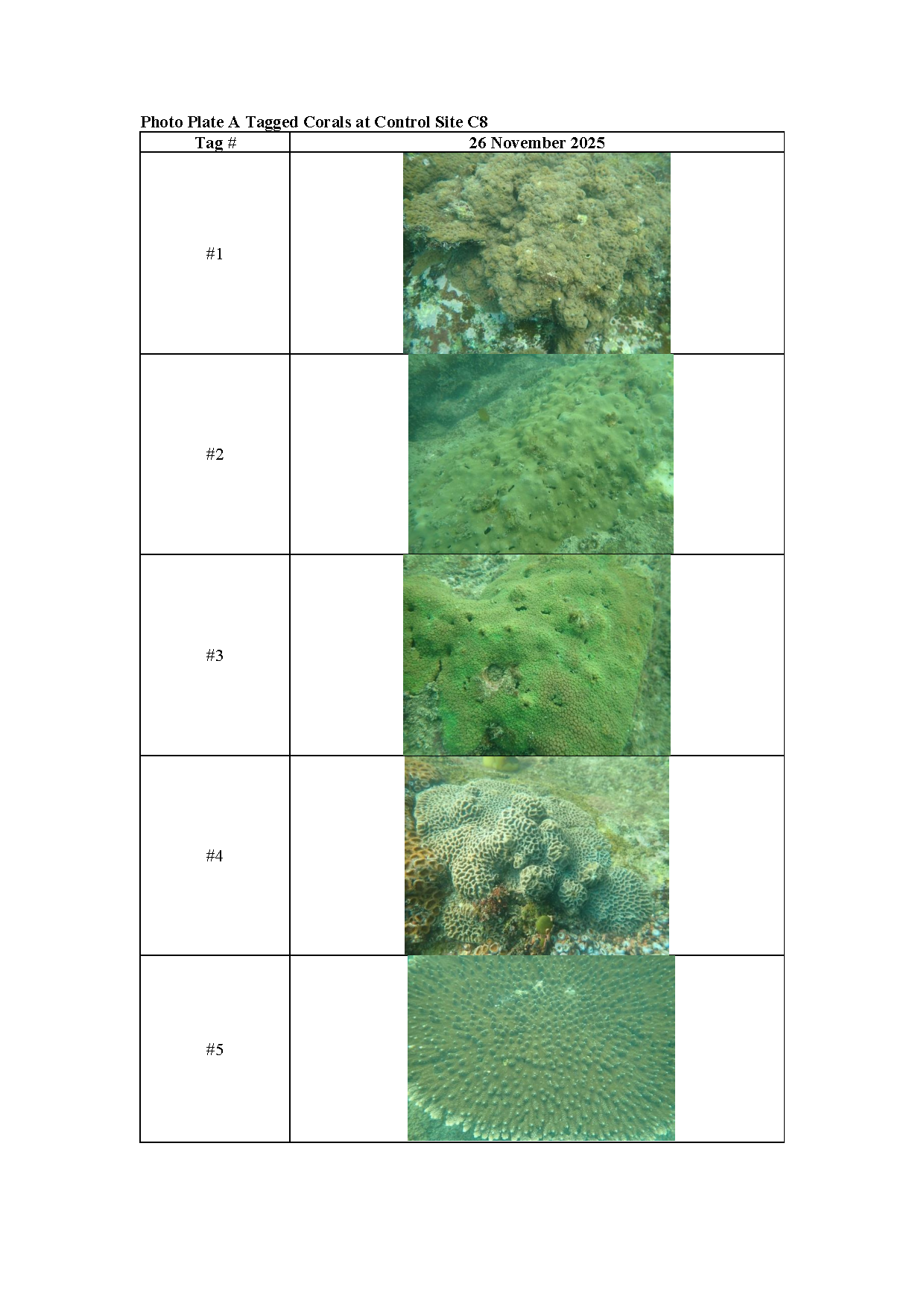
Table 3.2 Sizes, Condition, Mortality, Bleaching and Sediment of 10 Natural Coral Colonies at Control Site C8 during November 2025 Coral Monitoring Survey
Tag # |
Species |
Size (cm) – Max. Diameter |
Condition |
Mortality (%) |
Bleaching (%) |
Sediment (%) |
|||
|
|
|
|
Baseline |
26-Nov |
Baseline |
26-Nov |
Baseline |
26-Nov |
1 |
Favites pentagona |
75 |
Good |
0 |
0 |
0 |
0 |
0 |
0 |
2 |
Porites lutea |
64 |
Good |
0 |
0 |
0 |
0 |
0 |
0 |
3 |
Plesiastrea versipora |
38 |
Good |
0 |
0 |
0 |
0 |
0 |
0 |
4 |
Platygyra carnosus |
35 |
Good |
0 |
0 |
0 |
0 |
0 |
0 |
5 |
Acropora solitaryensis |
39 |
Good |
0 |
0 |
0 |
0 |
0 |
0 |
6# |
Acropora solitaryensis |
48 |
Good |
0 |
0 |
0 |
0 |
0 |
0 |
7# |
Bernardpora stutchburyi |
19 |
Good |
0 |
0 |
0 |
0 |
0 |
0 |
8 |
Favites pentagona |
24 |
Good |
0 |
0 |
0 |
0 |
0 |
0 |
9 |
Platygyra carnosus |
29 |
Good |
0 |
0 |
0 |
0 |
0 |
0 |
10 |
Acropora solitaryensis |
34 |
Good |
0 |
0 |
0 |
0 |
0 |
0 |
#newly tagged coral colony
Table 3.3 Sizes, Condition, Mortality, Bleaching and Sediment of 10 Natural Coral Colonies at Indirect Impact Site C2 during November 2025 Coral Monitoring Survey
Tag # |
Species |
Size (cm) – Max. Diameter |
Condition |
Mortality (%) |
Bleaching (%) |
Sediment (%) |
|||
|
|
|
|
Baseline |
26-Nov |
Baseline |
26-Nov |
Baseline |
26-Nov |
1# |
Dipsastraea speciosa |
18 |
Good |
0 |
0 |
0 |
0 |
0 |
0 |
2 |
Favites abdita |
43 |
Good |
0 |
0 |
0 |
0 |
0 |
0 |
3 |
Duncanopsammia peltata |
48 |
Good |
0 |
0 |
0 |
0 |
0 |
0 |
4# |
Platygyra carnosus |
21 |
Good |
0 |
0 |
0 |
0 |
0 |
0 |
5 |
Favites pentagona |
23 |
Good |
0 |
0 |
0 |
0 |
0 |
0 |
6 |
Plesiastrea versipora |
23 |
Good |
0 |
0 |
0 |
0 |
0 |
0 |
7 |
Dipsastraea rotumana |
27 |
Good |
0 |
0 |
0 |
0 |
0 |
0 |
8 |
Dipsastraea speciosa |
20 |
Good |
0 |
0 |
0 |
0 |
0 |
0 |
9 |
Porites lutea |
42 |
Good |
0 |
0 |
0 |
0 |
0 |
0 |
10 |
Porites lutea |
43 |
Good |
0 |
0 |
0 |
0 |
0 |
0 |
#newly tagged coral colony
Table 3.4 Sizes, Condition, Mortality, Bleaching and Sediment of 10 Natural Coral Colonies at Indirect Impact Site C3 during November 2025 Coral Monitoring Survey
Tag # |
Species |
Size (cm) – Max. Diameter |
Condition |
Mortality (%) |
Bleaching (%) |
Sediment (%) |
|||
|
|
|
|
Baseline |
26-Nov |
Baseline |
26-Nov |
Baseline |
26-Nov |
11 |
Acropora solitaryensis |
39 |
Fair |
0 |
40 |
0 |
0 |
0 |
0 |
12 |
Platygyra carnosa |
32 |
Good |
0 |
0 |
0 |
0 |
0 |
0 |
13 |
Favites pentagona |
34 |
Good |
0 |
0 |
0 |
0 |
0 |
0 |
14 |
Platygyra carnosa |
26 |
Good |
0 |
0 |
0 |
0 |
0 |
0 |
15 |
Dipsastraea veroni |
25 |
Fair |
0 |
0 |
0 |
0 |
0 |
0 |
16 |
Favites flexuosa |
21 |
Good |
0 |
0 |
0 |
0 |
0 |
0 |
17 |
Favites chinensis |
57 |
Good |
0 |
10 |
0 |
0 |
0 |
0 |
18 |
Plesiastrea versipora |
24 |
Good |
0 |
10 |
0 |
0 |
0 |
0 |
19 |
Duncanopsammia peltata |
32 |
Good |
0 |
0 |
0 |
0 |
0 |
0 |
20 |
Platygyra carnosus |
26 |
Good |
0 |
0 |
0 |
0 |
0 |
0 |
#newly tagged coral colony
Figure 1 Two Proposed Indirect Impact Sites (C2 and C3) during Operation Phase
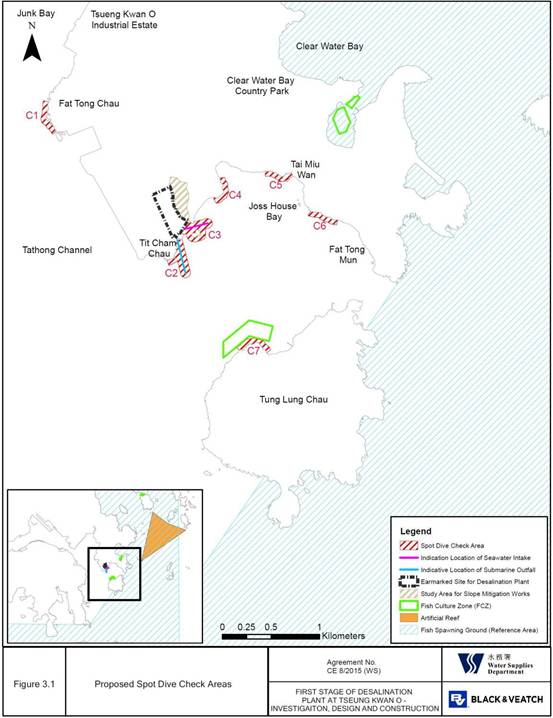
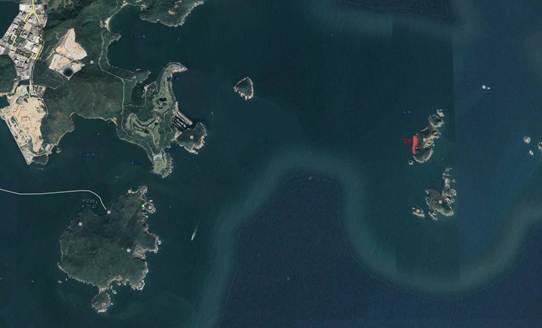
Figure 2 Proposed Control Site (C8) during Operation Phase
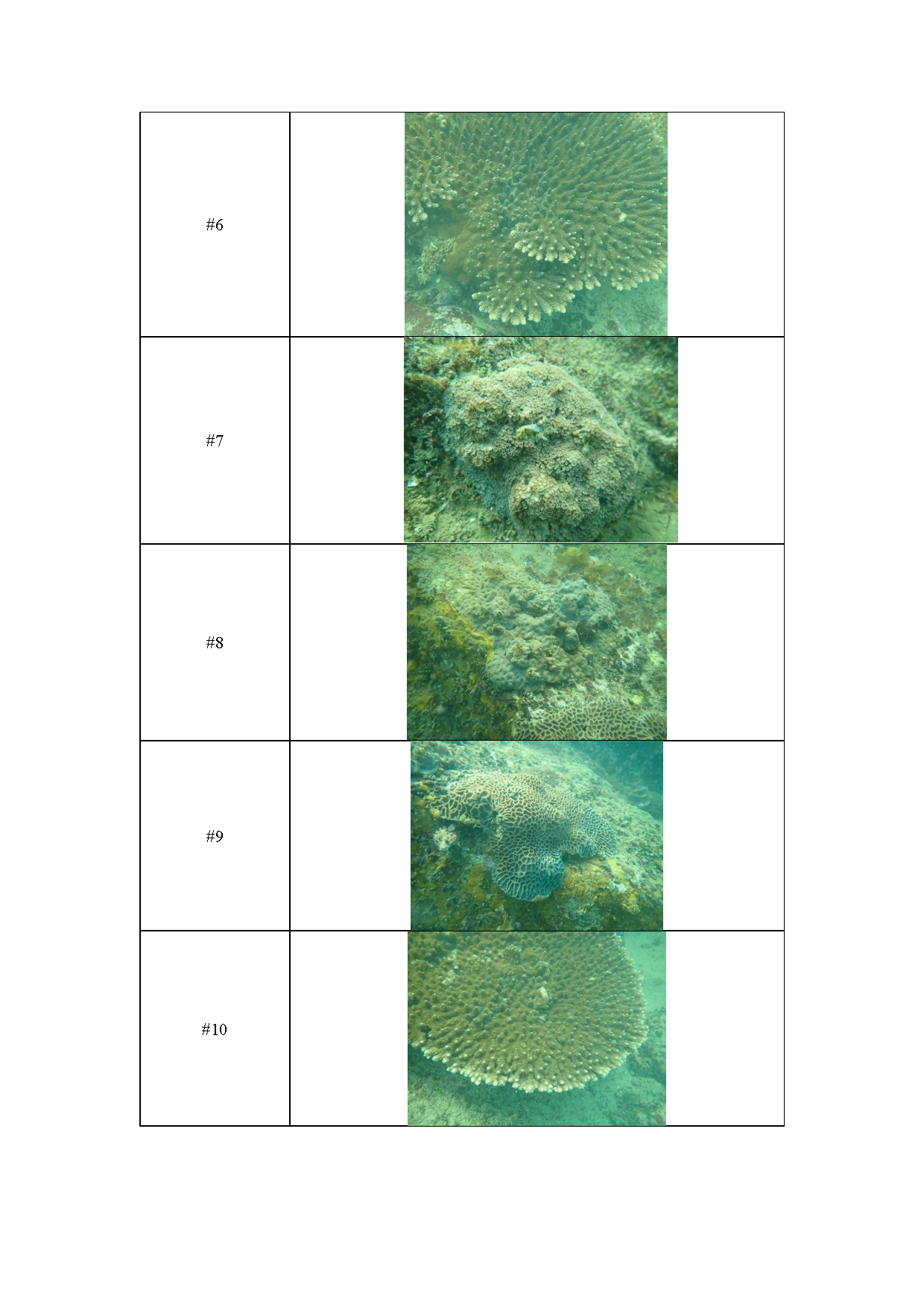
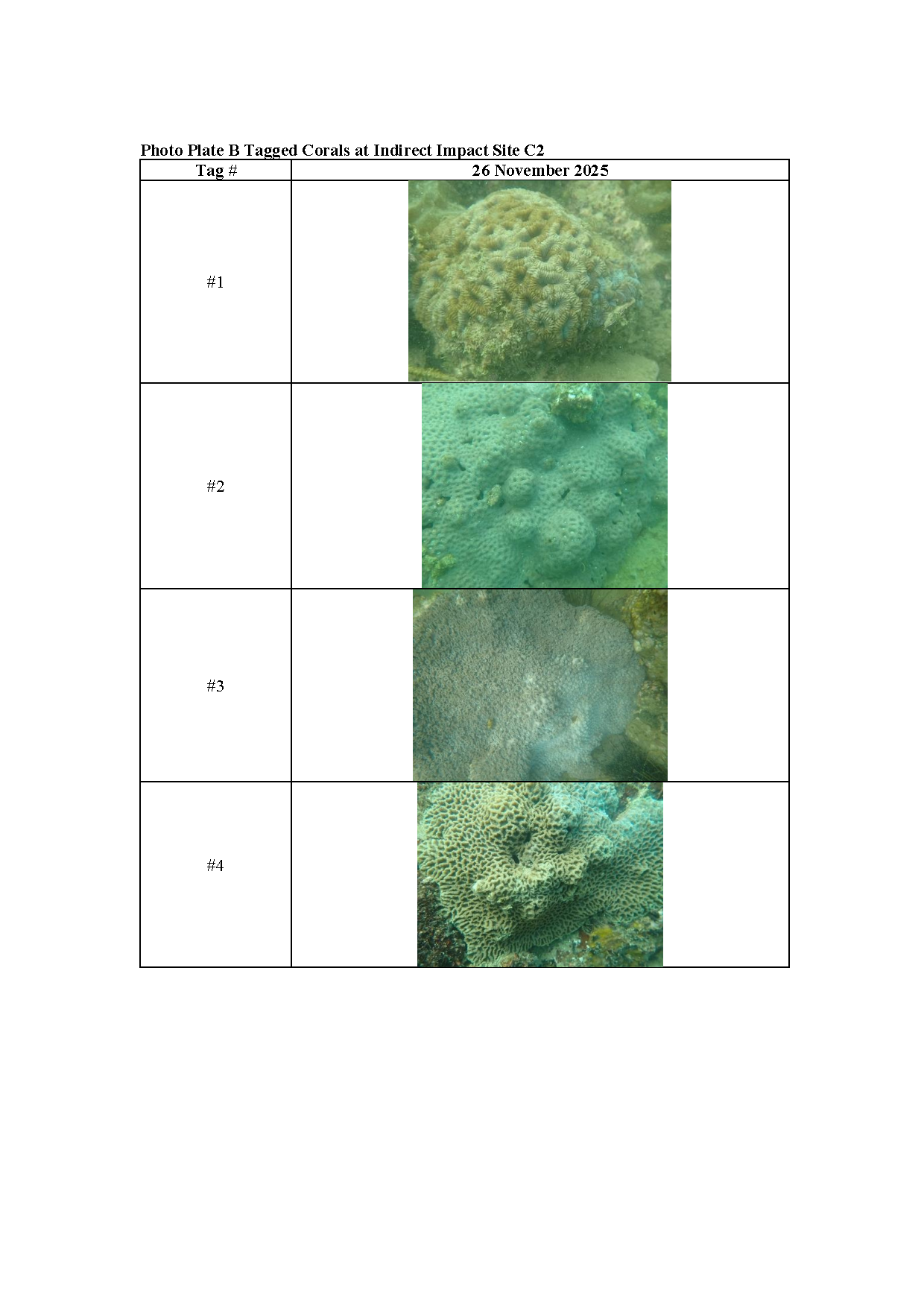
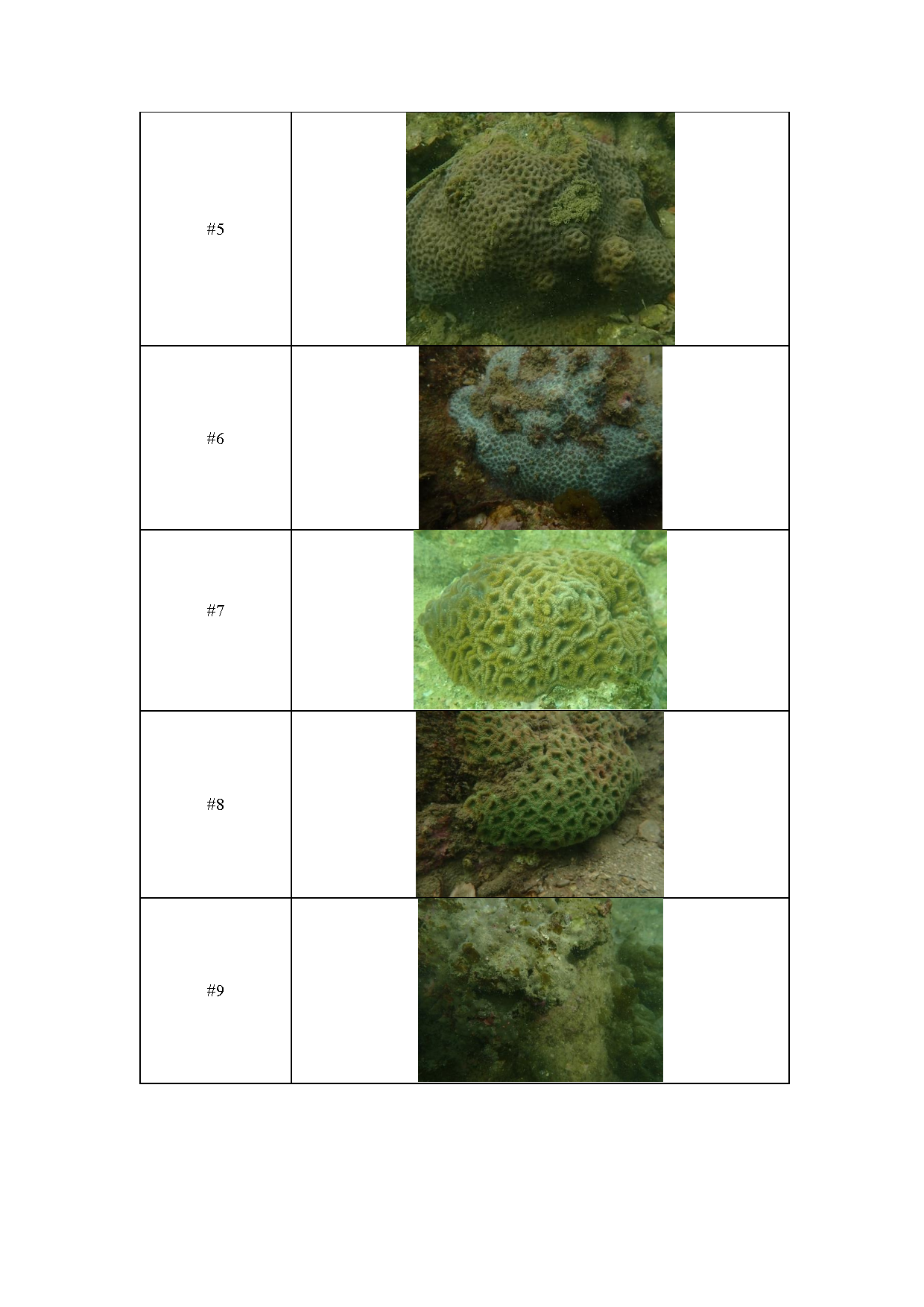
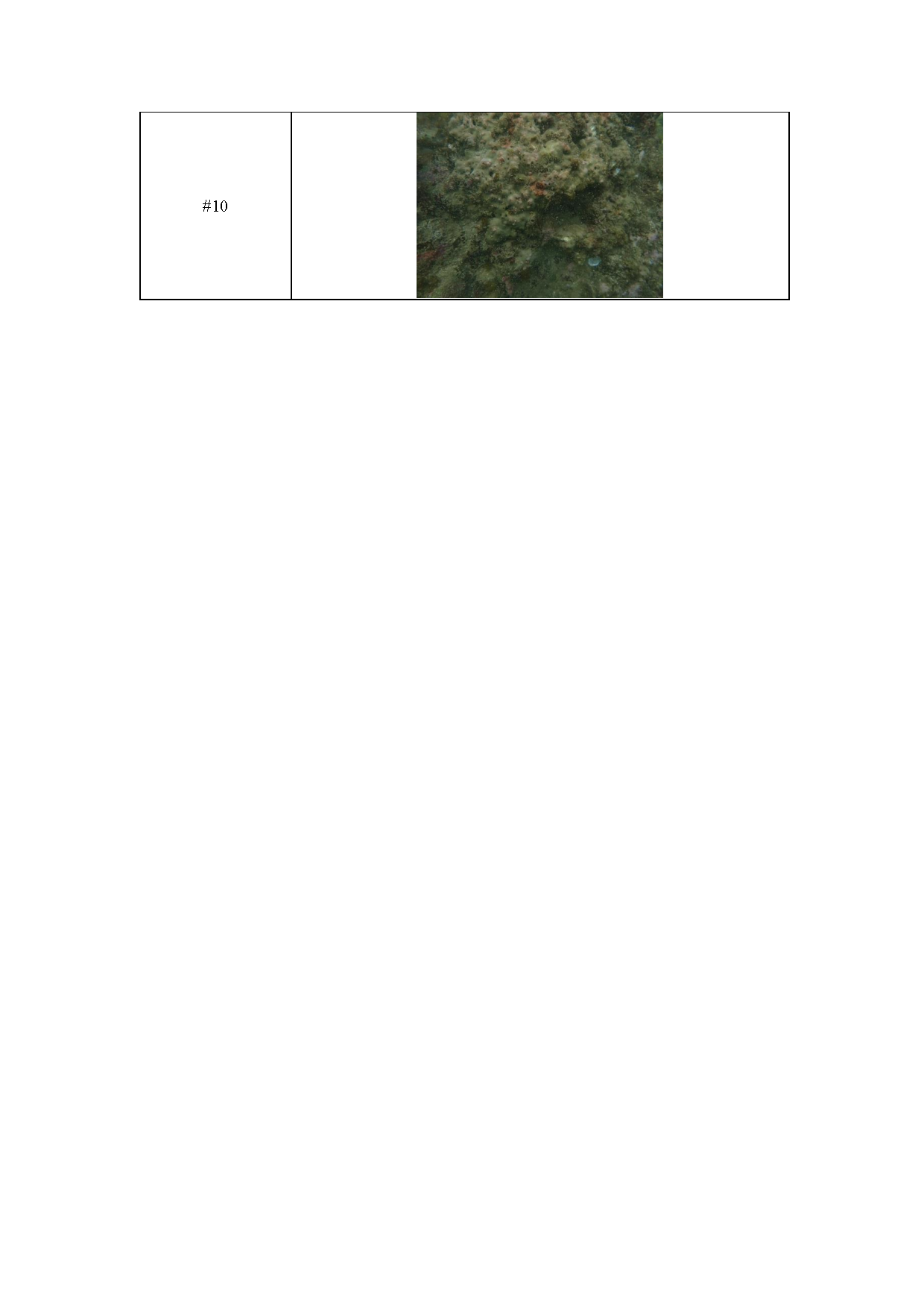
THE END
Appendix G Waste Flow Table
Name of Department: WSD Contract No.: 13/WSD/17
Month |
Actual Quantities of Inert C&D Materials Generated Monthly |
Actual Quantities of C&D Wastes Generated Monthly |
|||||||||
Total Quantity Generated |
Hard Rock and Large Broken Concrete |
Reused in the Contract |
Reused in other Projects |
Disposed as Public Fill |
Imported Fill |
Metals |
Paper/ cardboard packaging |
Plastics
(see Note 3) |
Chemical Waste |
Others, e.g. general refuse |
|
(in '000kg) |
(in '000kg) |
(in '000kg) |
(in '000kg) |
(in '000kg) |
(in '000kg) |
(in '000 kg) |
(in '000kg) |
(in '000kg) |
(in '000kg) |
(in '000kg) |
|
Jan |
0.000 |
0.000 |
0.000 |
0.000 |
0.000 |
0.000 |
0.000 |
0.000 |
0.000 |
0.000 |
38.740 |
Feb |
0.000 |
0.000 |
0.000 |
0.000 |
0.000 |
0.000 |
0.000 |
0.000 |
0.000 |
0.000 |
18.330 |
Mar |
30.520 |
0.000 |
0.000 |
0.000 |
30.520 |
0.000 |
0.000 |
0.000 |
0.000 |
0.000 |
29.050 |
Apr |
21.290 |
0.000 |
0.000 |
0.000 |
21.290 |
0.000 |
0.000 |
0.000 |
0.000 |
0.000 |
73.450 |
May |
0.000 |
0.000 |
0.000 |
0.000 |
0.000 |
0.000 |
0.000 |
0.000 |
0.000 |
0.000 |
35.720 |
Jun |
0.000 |
0.000 |
0.000 |
0.000 |
0.000 |
0.000 |
0.000 |
0.000 |
0.000 |
0.000 |
28.950 |
Sub-total |
51.810 |
0.000 |
0.000 |
0.000 |
51.810 |
0.000 |
0.000 |
0.000 |
0.000 |
0.000 |
224.240 |
Jul |
0.000 |
0.000 |
0.000 |
0.000 |
0.000 |
0.000 |
0.000 |
0.000 |
0.000 |
1.434 |
13.330 |
Aug |
0.000 |
0.000 |
0.000 |
0.000 |
0.000 |
0.000 |
0.000 |
0.000 |
0.000 |
0.000 |
27.340 |
Sep |
0.000 |
0.000 |
0.000 |
0.000 |
0.000 |
0.000 |
0.000 |
0.000 |
0.000 |
0.000 |
0.000 |
Oct |
0.000 |
0.000 |
0.000 |
0.000 |
0.000 |
0.000 |
0.000 |
0.000 |
0.000 |
0.000 |
13.710 |
Nov |
0.000 |
0.000 |
0.000 |
0.000 |
0.000 |
0.000 |
0.000 |
0.000 |
0.000 |
0.000 |
14.270 |
Dec |
|
|
|
|
|
|
|
|
|
|
|
Total |
51.810 |
0.000 |
0.000 |
0.000 |
51.810 |
0.000 |
0.000 |
0.000 |
0.000 |
1.434 |
292.890 |
Notes: (1) The performance targets are given in Section 1.69 of Specification B
Appendix I
Site Inspection Proforma
Appendix J Complaint Log
Statistical Summary of Environmental Complaints
Reporting Period |
Environmental Complaint Statistics |
||
Frequency |
Cumulative |
Complaint Nature |
|
1 – 30 November 2025 |
0 |
2 |
N/A |
Statistical Summary of Environmental Summons
Reporting Period |
Environmental Summons Statistics |
||
Frequency |
Cumulative |
Details |
|
1 – 30 November 2025 |
0 |
0 |
N/A |
Statistical Summary of Environmental Prosecution
Reporting Period |
Environmental Prosecution Statistics |
||
Frequency |
Cumulative |
Details |
|
1 – 30 November 2025 |
0 |
0 |
N/A |